Urgent Water Line Repair in Bellevue, WA
By Ramin Shahbaziasl, Owner, Eastside Repipe and Plumbing · Last updated October 09, 2025
Water line broken right now? Call 425-331-2011. We answer 24 hours a day across Bellevue and the Eastside.
Water line breaks do not wait for a convenient time. One minute everything is fine, the next there is water pooling across the floor, soaking walls, and threatening appliances.
Panic is a natural reaction but it is not a plan. Here is what to do in the first few minutes, how to tell a frozen pipe from a burst one, and when the problem needs a professional.
Key Points
Shutting off the water is the single step that limits the damage
Frozen and burst pipes need different responses
Early warning signs appear well before a break
Prevention costs a fraction of emergency repair
What Causes Water Line Failures
Aging or corroded pipes. Older metal supply lines weaken over time and eventually leak or split. Our guide to rusted pipe repair covers when repair stops making sense
Sudden temperature drops. Freezing water expands inside the pipe and creates pressure the material cannot take
High water pressure. Anything above 80 PSI stresses joints and fittings continuously
Tree roots. Roots grow toward underground lines and can penetrate them
Early Warning Signs
Slow or no water flow
Hissing, bubbling, or popping sounds
Damp spots on walls or ceilings
A water bill higher than usual with no change in habits
Reduced pressure across multiple fixtures
A test worth running. Turn off every fixture and appliance, note your water meter reading, wait two hours, and read it again. Any movement means water is escaping somewhere. Our guide to detecting a hidden water leak covers this in more detail.

What to Do in the First Ten Minutes
Turn off the main water supply. This is the step that limits the damage, and everything else can wait until it is done
Electricity: be careful here. If water is near outlets or the panel, do not operate switches while standing in water. CDC guidance on flooded homes is to call an electrician rather than wading to a panel yourself
Identify the source if you can. Look for wet spots, listen for hissing or popping, and check for frost on exposed pipes
Contain the water. Buckets, towels, and something to keep it off finished flooring
Photograph everything before cleaning up. Insurers ask for it
Assess whether it is a minor leak or a major break, and call if it is the latter
Why Waiting Costs More
The plumbing repair does not change much between now and tomorrow. The damage does.
Water moving through drywall, along joists, and under flooring is what turns a plumbing bill into a plumbing bill plus a restoration contractor. Mould establishes within days once a cavity is wet.
Insurance treats the two differently as well. Sudden accidental damage is generally covered, while damage that worsened because it was left is more often disputed.
Frozen Pipes and Burst Pipes Are Different Problems
Frozen, not yet burst. Frost on the pipe, no water flow at a fixture, or unusual popping sounds. This is the best possible moment to act, because the pipe is still intact.
Leave the affected faucet open so melting water has somewhere to go
Apply gentle heat, working from the faucet back toward the frozen section
Never use an open flame
If you cannot locate or reach it, call before it thaws
Burst. The pipe has already failed, and water is escaping. Shut off the main immediately, then follow the steps above.
Our guides to frozen pipe repair and burst pipe repair cover each in depth.
What Professional Repair Involves
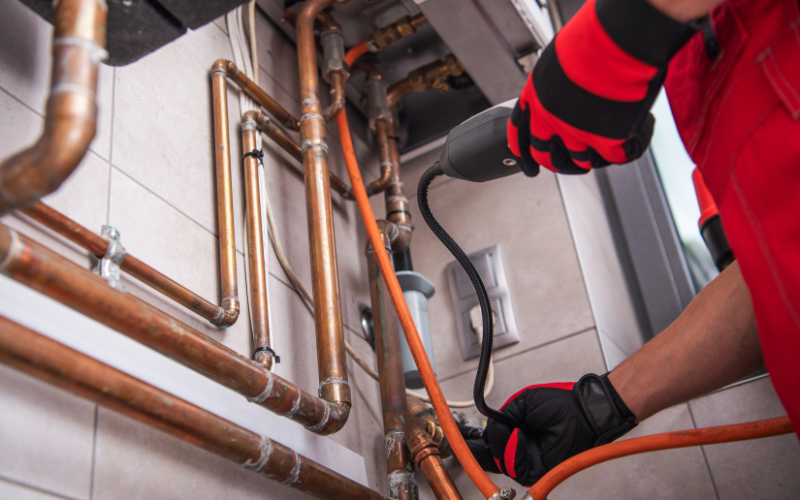
Diagnosis. We establish where the loss is and what caused it, rather than repairing the visible symptom and leaving the cause in place.
Repair or replacement. A failed joint is a spot repair. A corroded run may be worth replacing. If the system is failing in several places, that is a different conversation, and our repiping services page covers it.
Testing. Pressure tested before anything closes up.
A check of the surrounding system, because a pipe that failed at one point is usually the same age and condition either side of it.
On scope: our leak detection covers interior plumbing systems, including fixtures, exposed piping, and plumbing within accessible wall spaces. We do not perform underground water line detection between the meter and the home, or exterior excavation. If the problem sits outside the building, we will tell you that rather than charging you to find out.
Before hiring anyone for emergency plumbing work, it is worth confirming they are properly licensed. You can verify any Washington plumbing contractor's licence, bond, and insurance for free through the state Department of Labor and Industries.
DIY or Professional
Reasonable to handle yourself: shutting off the water, containing the spread, documenting the damage, and gently thawing an accessible frozen pipe that has not yet split.
Worth calling for: anything involving a pressurized line, water near electrics, a break you cannot locate, or a pipe that has already burst. An improper repair on a supply line fails inside finished construction, which is the most expensive category of plumbing failure.
Preventing the Next One
Routine checks
Inspect exposed pipes annually
Monitor water pressure and keep it in the 40 to 80 PSI range
Replace aging supply lines before they fail rather than after
Winter preparation
Insulate pipes in crawl spaces, garages, and exterior walls
Hold indoor temperatures steady, and no lower than 55°F when travelling
Drain and disconnect outdoor hoses before the first freeze
Our winterizing guide covers the full seasonal prep
Monitoring
Leak sensors near the water heater, under sinks, and in the crawl space
Automatic shut-off valves, which stop a failure before you get home
Teach everyone in the household where the main shutoff is and confirm it turns
An annual whole home plumbing inspection catches most of this while it is still scheduled work.
Frequently Asked Questions
How fast should I act during a water line emergency?
Immediately. Shut off the water, contain the leak, and call. Acting in the first ten minutes is usually the difference between a plumbing repair and a restoration project.
Can frozen pipes cause water line emergencies?
Yes. Ice expanding inside a pipe creates pressure that cracks or splits it. Addressing a frozen pipe before it bursts is far cheaper than after.
How much does urgent water line repair cost?
It depends on severity, location, and pipe type. Preventive work is almost always cheaper than emergency repair. Our plumber cost guide covers typical local pricing.
What is the difference between frozen pipe repair and burst pipe repair?
Frozen pipe repair addresses a pipe before it breaks, usually by thawing it safely and then insulating it. Burst pipe repair fixes a pipe that has already failed.
Can I prevent water line emergencies completely?
No guarantee, but regular inspection, proper insulation, pressure management, and leak monitoring reduce the risk substantially.
Do you handle underground water line problems?
Our work covers interior plumbing systems. If the fault sits between the meter and the house, or requires excavation, we will point you to the right specialist rather than take it on.
Call Before It Floods
If water is moving and you cannot stop it, shut off the main and pick up the phone. Everything else can be sorted once the water is off.
425-331-2011 — 24 hours a day, seven days a week.
You can also book online if the situation is contained. See our emergency plumbing service for the full scope.
We serve Bellevue, Kirkland, Redmond, Bothell, Renton, Issaquah, Sammamish, Seattle, and the wider Eastside service area.
