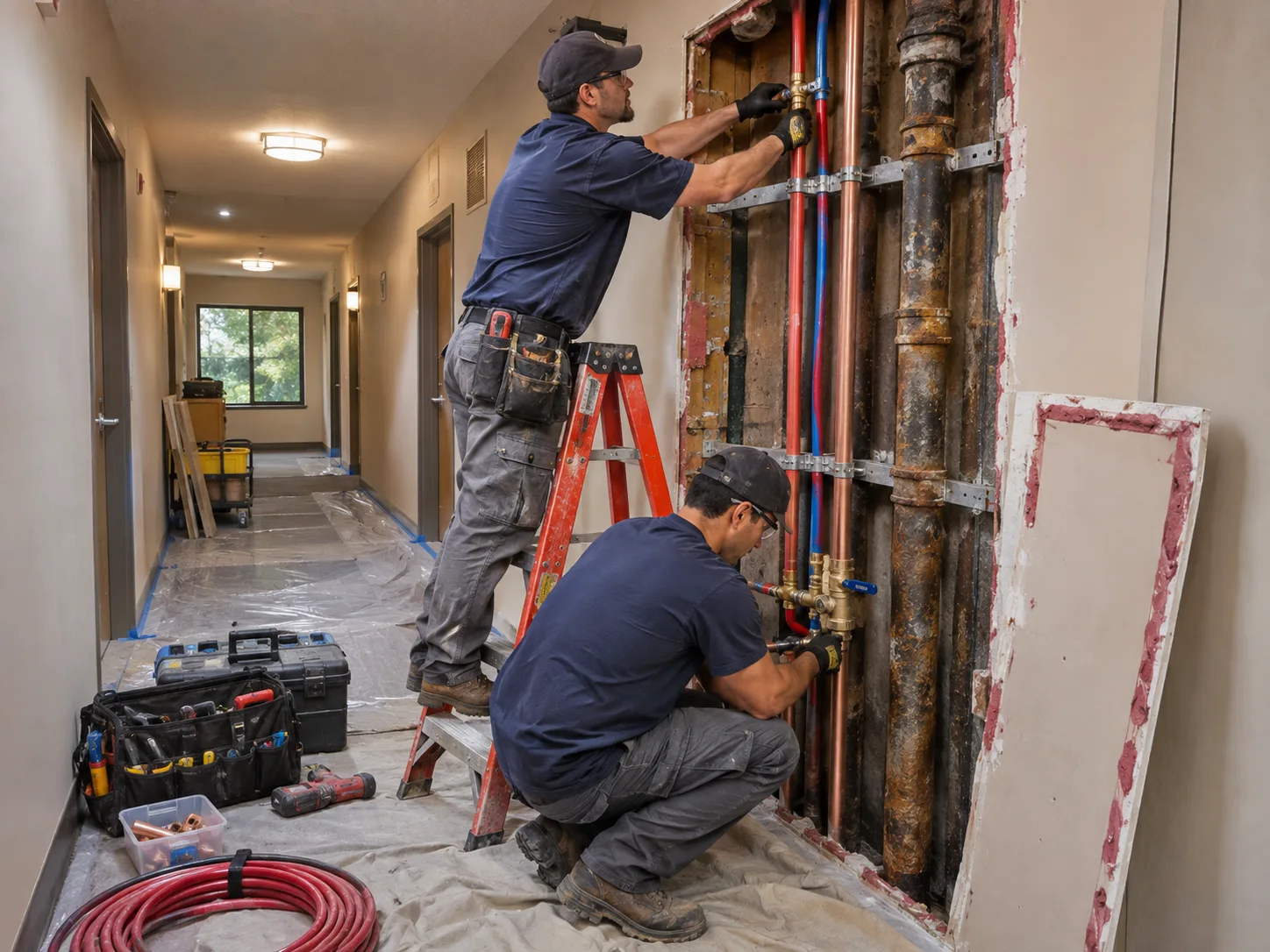
What Do Commercial Repipe Specialists Do In Bellevue?
Commercial repipe specialists will completely replace the old water lines in your apartment, condo, office or mixed use building for you. We plan our repiping project in Bellevue and Mercer Island to minimize disruptions to your tenants by planning to fit the new plumbing to your buildings risers, tenants and local codes.
By Ramin Shahbaziasl, Owner and Lead Plumber · Last updated November 10, 2026
What makes commercial repipe specialists different from house repipers?
We are looking at a small difference in scale. A domestic property will have one water main. A 30 unit building will have multiple stacks, shared shut off points and many people who cannot be without water for a day.
When asked how is a commercial building repiped, the first stage would be to survey the property. There is more to it than just the plumbing:
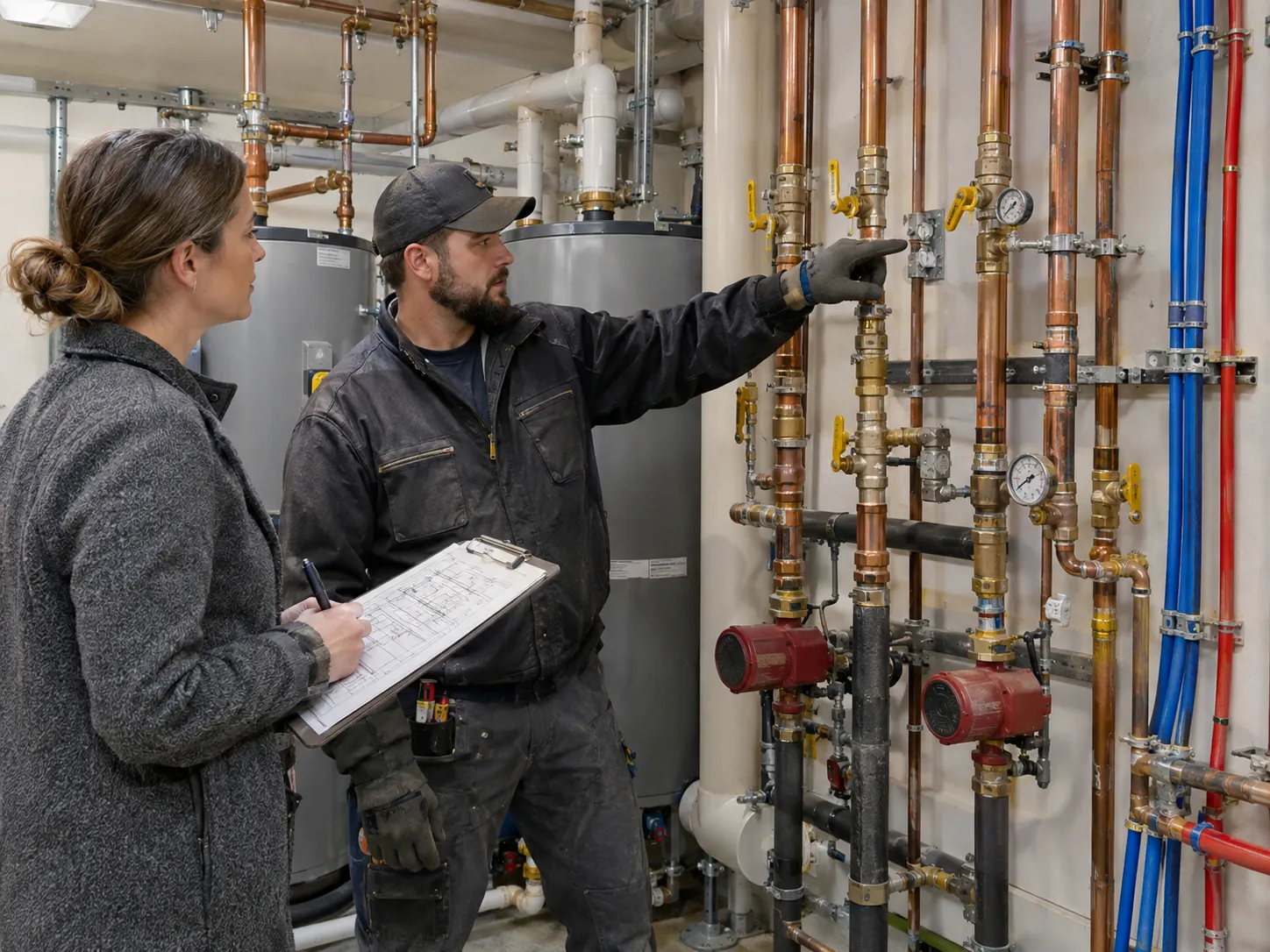
Mapping every riser, valve and branch, often without original drawings
Permits and inspections timed so walls aren't left open for days
Access plans worked out with the property manager or HOA board
Material choices that suit the building's pressure and height
That's why a plumber who does great whole-house repiping isn't automatically set up for a 4-story building.
What are risers and branch lines, and why do they matter?
Risers and branch lines are the two halves of a building's water system. Risers are the vertical pipes that carry water up through the floors. Branch lines, on the other hand, are the smaller runs that feed each unit's fixtures.
Because one riser feeds a whole column of units, a leak there affects everyone on that stack. Branch line leaks, by contrast, tend to stay inside one unit.
This split decides the scope. For example, if only branch lines are failing, a partial repipe may be enough. If the risers are corroded, though, new branches would just tie into a failing backbone.
Before quoting, we look at:
Where each riser starts and which units it feeds
Whether the valves at the base of each riser still close fully
Pipe size and material on every level
How the hot water recirculation loop returns to the water heater
That hot water loop matters because water moving constantly through copper wears it from the inside. So in many buildings, it fails years before the cold side.
Which pipe problems mean a building needs a full repipe?
Sometimes a complete repipe is required due to multiple failures of stacks and/or if you know the material fails. Often the age of building will give you an insight.
Pipe material | Common in buildings from | What failure looks like | Usual direction |
Galvanized steel | Before the 1960s | Rusty water, weak pressure on upper floors, leaks at threaded joints | Full repipe, risers first |
Thin-wall copper (Type M) | 1960s to 1990s | Pinhole leaks, green staining, repeat wet ceilings | Repipe once pinholes show up across stacks |
Polybutylene | Late 1970s to mid-1990s | Gray flexible pipe, sudden fitting failures | Full replacement |
Kitec (PEX-AL-PEX) | Roughly 1995 to 2007 | Orange or blue pipe, corroded brass fittings, falling flow | Replace the affected runs |
CPVC | 1980s onward | Brittle pipe, cracks near fittings | Depends on age and failure pattern |
Older Eastside buildings often fall into the first two rows. See our guides on galvanized pipe replacement and polybutylene pipe replacement for more.
Here's a simple rule of thumb. If you're patching the same stack a few times a year, you're already paying for a repipe in installments. When it's time to choose, our PEX vs copper guide explains the trade-offs.
What does Bellevue code require when metal water pipe comes out?
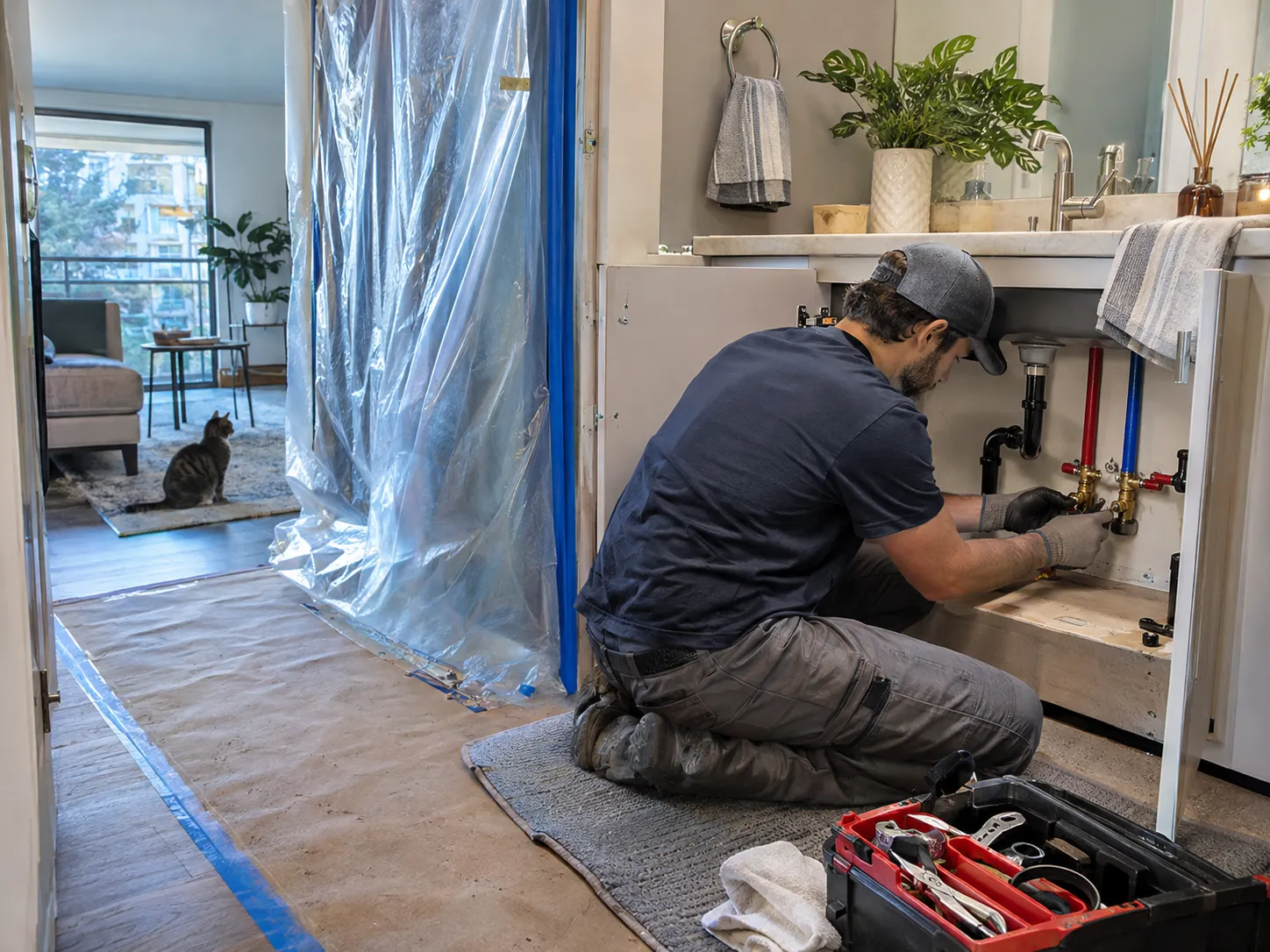
If a building's metal water pipe is part of its electrical grounding, the City of Bellevue requires that grounding to stay intact when the pipe is replaced. This catches owners off guard, especially when metal pipe is swapped for PEX.
Bellevue's grounding and re-piping guidance says installers must maintain grounding under NEC 250.50 and UPC 604.8 on residential and commercial repipes. When metal is replaced with plastic, the city prefers 10 feet of new metal pipe from the foundation out, in contact with soil, with the ground clamp reattached. Bonding work also needs an electrical permit.
In practice, grounding gets checked during the survey, not after the old pipe is gone.
Licensing matters just as much. Before you sign with any commercial repipe contractors in Mercer Island WA or Bellevue, check them with the state's Verify a Contractor, Tradesperson or Business tool. It shows license status, bond, insurance and infractions.
What goes wrong on a commercial repipe that isn't planned well?
Most problems on building repipes come from skipped planning, not bad pipe. The same handful of issues show up again and again:
Seized base valves that won't close, which forces a wider shutdown than tenants were promised
Lost grounding when metal pipe comes out and nobody checks the bond
Pressure surprises in taller buildings with unmapped booster pumps or pressure zones
Slow hot water in far units when the recirculation loop isn't rebalanced
Unsealed fire-rated walls, since new penetrations need a listed firestop system
Disturbed backflow assemblies that must be retested before closeout
None of these are rare. Instead, they're predictable, so a good survey prevents most of them.
What shapes the timeline on Mercer Island and Bellevue buildings?
The size of the building, the level of access and the tenants will have a big impact on how long does a commercial repipe take. A small building (8-12 units) will often take a short amount of time (a few weeks), while a large complex with several buildings can take longer (a few months).
Local factors:
Mercer Island must be delivered across the I-90 bridges. In addition, many buildings within town center have retail spaces on their first floor and residential units above meaning deliveries are scheduled carefully.
Bellevue from the towers of downtown (with pump rooms) to the older garden complexes around crossroads and eastgate. Work is scheduled building by building.
That's why the schedule follows tenant hours first. A dental office can't lose water at 10 a.m., but it may not mind at 6 a.m.
Which buildings does Eastside Repipe And Plumbing repipe around Mercer Island and Bellevue?
If you've been searching for who repipes apartment and office buildings near Mercer Island and Bellevue WA, this is the work our crews are set up for:
Apartment and condo buildings, including HOA-managed properties
Small and mid-size office buildings
Mixed-use buildings with retail below and homes above
Older multi-building complexes with aging copper or galvanized risers
We're based on NE 12th St in Bellevue. As a result, repiping an occupied commercial building near Bellevue Washington doesn't mean crews crossing the lake at rush hour. We cover the Mercer Island and Bellevue service areas, plus Kirkland, Redmond, Issaquah, Sammamish, Newcastle and Renton. For a similar project, see our post on commercial repiping in Kirkland.
Above all, the right commercial repipe specialists will walk your building and put the plan in writing before a single wall is opened.
Frequently asked questions
1. Can tenants stay in the building while it is repiped?
Yes, tenants almost always stay put, because repiping an occupied building only needs each unit for a short window before crews move on. Most owners searching can a building stay open during a repipe are relieved to learn full closures are rare, and Washington law (RCW 59.18.150) requires at least two days' written notice before entering residential units.
2. How is the work phased across floors and units?
The work is phased one riser at a time, because each riser feeds a vertical column of units. A typical phased repipe schedule adds new isolation valves first, then replaces, tests and switches over one stack before moving to the next.
3. How is a commercial job priced against a house?
A commercial job is priced by the riser and the unit, while a house is usually one flat bid for the whole home. The total is higher than a house, but the cost per unit is often lower because crews repeat the same layout floor after floor.
4. How much water shutdown does each unit actually see?
Each unit usually loses water for a few hours on one or two days, not for the whole project. The longest break comes when that unit's branch lines are switched from the old riser to the new one.
5. What gets restored afterwards, and who does that work?
Everything opened to reach the pipe gets put back, including drywall, texture, paint and any tile or cabinets that came out. Who handles that finish work should be written into the contract, since tile and custom cabinetry often go to a separate trade.
Visit or Call Us
Eastside Repipe And Plumbing
Address: 12005 NE 12th St # 29, Bellevue, WA 98005
Phone: 425-331-2011
Email: [email protected]
Family-owned plumbing and repiping company
Serving Mercer Island, Bellevue, Kirkland, Redmond, Issaquah, Sammamish, Newcastle and Renton. Call for a free estimate, or use our contact page to book a visit.
