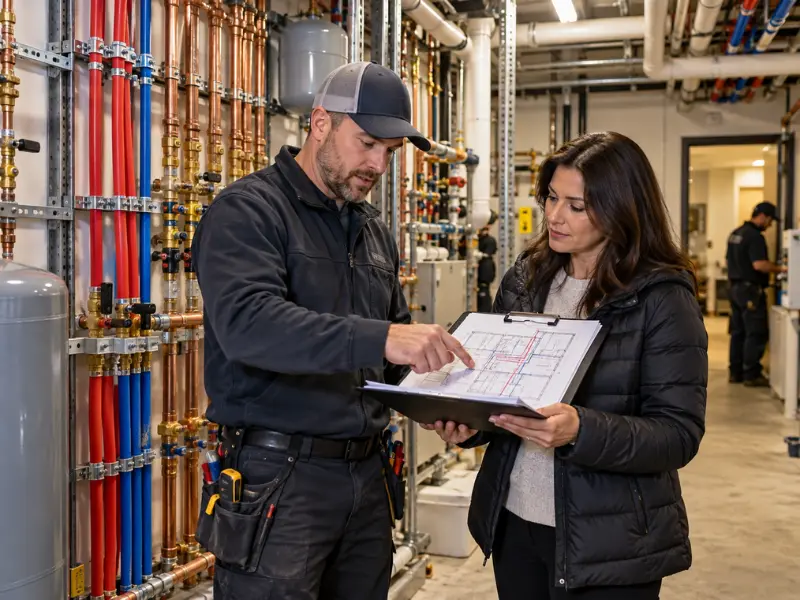
How Does Commercial Repiping Work In Kirkland?
Commercial repiping in Kirkland replaces a building's old water lines one section at a time. That way, tenants keep running water while crews move riser by riser or stack by stack. First, the system gets mapped and permitted. Then each phase is scheduled with the property manager, and walls are patched before the crew moves on.
By Ramin Shahbaziasl, Owner and Lead Plumber · Updated October 19, 2026.
What does commercial and multifamily repiping in Kirkland cover?
It covers every pipe that carries drinking water from the main shutoff to each fixture. So when owners start searching for commercial and multifamily repiping Kirkland options, a real bid should list:
Main lines from the meter or mechanical room
Risers, the vertical pipes feeding each floor or stack of units
Branch lines inside each unit, out to every fixture
New shutoff valves, so one unit can be isolated on its own
Firestopping where new pipe passes between floors
Drywall repair, texture and paint once the pipe work is done
So, what does a multifamily repipe involve beyond the pipe? Mostly coordination. In fact, the plumbing is often the easy part. The hard part is moving through occupied homes without anyone losing a full day of water.
Why do Kirkland apartment buildings need a repipe?
Most of them are simply wearing out the pipe they were built with. Plenty of complexes around Totem Lake, Juanita and Rose Hill went up between the 1970s and 1990s. As a result, their original supply lines are reaching the end of their working life.
Here's what we usually find when we open walls:
Pipe material | Common in buildings from | How it usually fails | What tenants notice first |
Galvanized steel | Before the 1970s | Rusts inside and narrows | Brown water, weak pressure |
Copper | 1960s to today | Pinhole leaks, often on hot lines | Ceiling stains below a unit |
Polybutylene (gray plastic) | Late 1970s to mid-1990s | Fittings crack without warning | Sudden leaks across units |
Mixed repairs | Any older building | Leaks where old meets new | The same problem keeps returning |
Still on galvanized? Our guide to galvanized pipe replacement in Kirkland explains why patching rarely holds.
Meanwhile, owners often ask us how do I know if my Kirkland apartment building needs a repipe. The real warning sign isn't one leak. It's a pattern. For example, three or four pinhole repairs on one riser in a year usually means the rest of it isn't far behind.
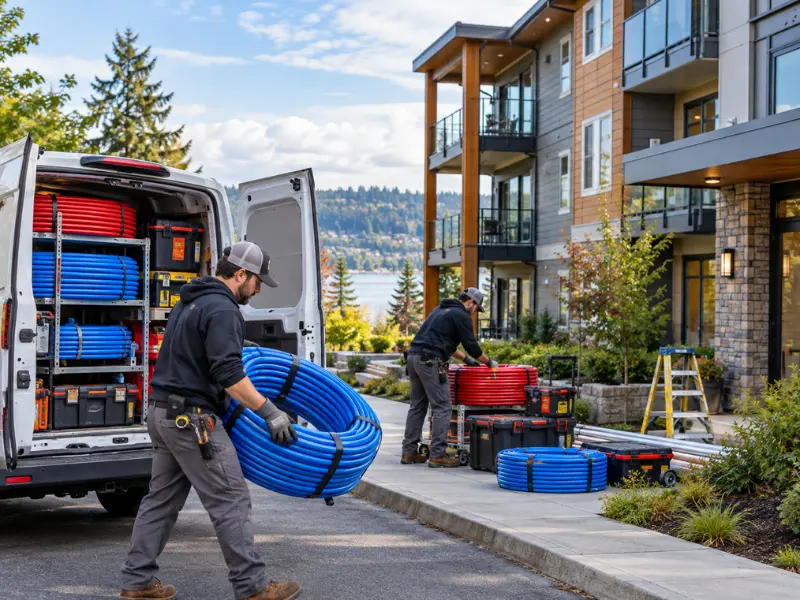
How does an apartment building repipe in Kirkland get planned?
It starts with a walk-through and a riser map, before anyone quotes a price. Many owners searching for apartment building repipe Kirkland help expect a number on day one. Still, a fair bid depends on what you can only see in person.
During the walk-through, we check:
How many risers feed the building and where their shutoffs sit
Wall access, including tile, cabinets and soffits
The mechanical room and water heater setup
Problem units with past leaks or complaints
Next comes the permit. The City of Kirkland requires plumbing permits for plumbing systems, and applications go through MyBuildingPermit.com. In addition, the city's checklist asks for a riser diagram on buildings with more than two units. It shows waste, vent and water pipe sizes. Buildings over three stories also need isometric drawings. So if you've wondered what permits are needed to repipe a commercial building here, the plumbing permit is the main one, backed by those drawings. That's why the riser map matters so much. It becomes the backbone of the permit set.
How does a phased repipe for occupied buildings in Kirkland work?
A phased repipe splits the building into small sections, so only one is ever without water. And even then, it's only for part of a day. It's the standard approach for anyone searching for a phased repipe for occupied buildings Kirkland tenants won't have to leave.
The key is picking the right unit of work:
Phasing method | How it works | Best fit | What tenants notice |
By riser or stack | Stacked units get done together | Mid-rise buildings | A few hours off on tie-in day |
By floor | One floor at a time | Buildings with mains on each floor | Crews nearby for a few days |
By building | One building in a complex at a time | Garden-style complexes | Nothing until their turn |
By zone | Sections split by valves or layout | Mixed-use and commercial spaces | Work set around business hours |
In practice, most Kirkland jobs mix two of these. For example, a garden-style complex might go building by building, then stack by stack inside each one.
What does a repipe week look like for residents?
Each unit usually sees crews for two to three working days. Residents also ask, do tenants need to move out during a building repipe? Almost never. Here's the usual rhythm:
Notice. Residents get a written schedule a few days ahead.
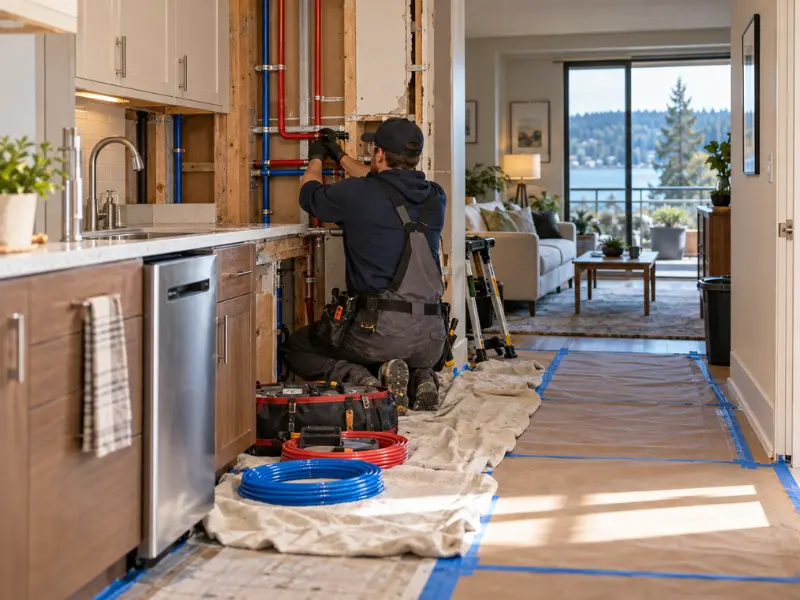
Day one. Crews cover floors and furniture, open small holes and run new lines.
Day two. New lines are tied in, pressure tested and inspected.
Day three. Drywall is patched, textured and painted to match.
Because the new pipe goes in before the old pipe comes out, the shutoff only covers the tie-in. As a result, residents cook and shower as normal for most of the week.
What goes wrong when a repipe isn't phased properly?
Rushed phasing leads to long shutoffs, failed inspections and angry tenants. We've been called in after other jobs went sideways. The same problems show up every time:
All-day shutoffs because tie-ins weren't planned
Dead legs, old capped pipe where stagnant water sits
Missing firestopping, which fails inspection
Patchy walls that don't match the texture or paint
Lost rent when tenants leave over weeks of disruption
Drains age too. If yours are as old as your supply lines, read our post on waste line replacement in Kirkland before you lock in a scope.
Why do Kirkland property managers choose Eastside Repipe and Plumbing?
Repiping is our core trade, not a side service. Our repiping services cover copper and PEX installs, risers and waste lines. Plus, our Bellevue office is a short drive from Kirkland.
People often ask us who repipes apartment and commercial buildings in Kirkland. Others ask which plumber near me handles multifamily repiping without subcontracting it. Either way, check the license first. Washington's L&I Verify tool shows whether a plumbing contractor has an active license, a current bond and workers' comp. Run every bidder through it, including us. See more on our Kirkland plumbing page.
How do you get a free commercial repiping estimate?
Call us or request your free estimate online, and we'll schedule a walk-through. Then you'll get a written scope, a phasing plan and a free estimate for your building.
Frequently asked questions
1. How do you repipe an occupied building without shutting off water for long?
We run the new pipe alongside the old system while it's still working, then switch over in one short tie-in per section. That tie-in is the only time water is off. We drain only the riser or zone being connected, and we flush and test the new line before reopening it.
2. Can the work be phased by riser or by stack?
Yes, but that is often the cleanest way to service a building with multiple risers. Each stack's dates are isolated, allowing the remainder of the building to be unaffected. In the case of risers that do not have functioning isolation valves, those will be installed, if necessary, as this is required to gain access to each stack individually.
3. How do you coordinate with property managers and residents?
You can have one point of contact and a written schedule to approve of prior to starting work. Residents will also receive notices printed out for their unit. Additionally, you will receive daily updates on what units have been completed as well as what units are next. Additionally, we will identify and address access issues before your office has to call around trying to find who has the keys in the morning.
4. What insurance limits and references can you provide for a project this size?
We'll send our current certificate of insurance with the bid, so you can check the limits against your requirements. If your contract calls for higher limits or an additional insured endorsement, tell us early. We'll confirm it before signing and share references from past repipe clients on request.
5. How do you handle access to individual units?
We follow an access schedule your office signs off on, using your key process or a staff escort. Residents can be home or away. Either way, we cover belongings and leave a note on what was done. If a unit can't be entered on its day, we move it to the end of that phase instead of holding up the stack.
6. How much does commercial repiping cost in Kirkland?
It depends mostly on the number of units, risers and fixtures, not square footage. Tile walls, pipe material and tight tenant schedules also move the price. That's why we quote each building after a walk-through, and the estimate is free.
7. How long does an apartment building repipe take?
A building of under 20 units can often be completed in a matter of weeks, and larger complexes can take a few months to finish. The review of permits always adds some time before the start of the work, therefore you should look into renovations before your water damage forces your hand. Once the work begins, each unit is typically finished in a matter of days.
8. Is PEX or copper better for a multifamily repipe?
PEX is more common for occupied buildings, as it is more flexible and requires fewer fittings and can be fed through smaller openings in the wall. Copper is still used in some circumstances, such as mechanical rooms and where code or circumstance require it. Many buildings use a combination of the two, with copper runs from the main and PEX run inside the unit.
Visit or Call Us
Eastside Repipe and Plumbing
Address: 12005 NE 12th St # 29, Bellevue, WA 98005
Phone: 425-331-2011
Email: [email protected]
Family-owned and locally operated, led by owner and lead plumber Ramin Shahbaziasl.
Serving Kirkland, Bellevue, Redmond, Bothell, Issaquah, Sammamish, Renton, Seattle and the Eastside.
