Where Does A PEX Repipe Run In A Mercer Island Home?
A PEX repipe on Mercer Island usually runs through the attic or crawlspace, then drops into walls through small openings to reach each fixture, so most walls stay closed. Eastside Repipe And Plumbing plans the route around each house, from mid-century ramblers on the north end to hillside and waterfront homes farther south.
By Ramin Shahbaziasl, Owner and Lead Plumber · Last updated November 11, 2026
Why do so many Mercer Island homes end up needing a PEX repipe?
Most Mercer Island repipes start because the original supply pipe is wearing out, not because anything sudden happened. The island's housing stock spans several decades, and each era brings its own pipe problems.
The usual suspects include:
Galvanized steel in older homes, which rusts from the inside and chokes water pressure on upper floors
Copper from the 1960s through the 1990s, which can develop pinhole leaks over time
Polybutylene in some homes from the late 1970s to the mid-1990s, which fails at the fittings with little warning
Water chemistry plays a part too. According to the city's 2025 water quality report, Mercer Island buys its water from Seattle Public Utilities, mainly from the Cedar River watershed. SPU adds lime to adjust pH for corrosion control, and the city completed a booster chlorination station in 2024 to keep chlorine levels steady across the island. The report also notes that the city maintains service lines but can't control the plumbing materials inside your home.
That last point matters. Once water passes your meter, the pipes are yours to manage. So when leaks start repeating, a planned repipe usually costs less than chasing one failure after another. If your home has galvanized or gray plastic pipe, see our guides to galvanized pipe replacement and polybutylene pipe replacement.
How is a PEX repipe routed through a Mercer Island house?
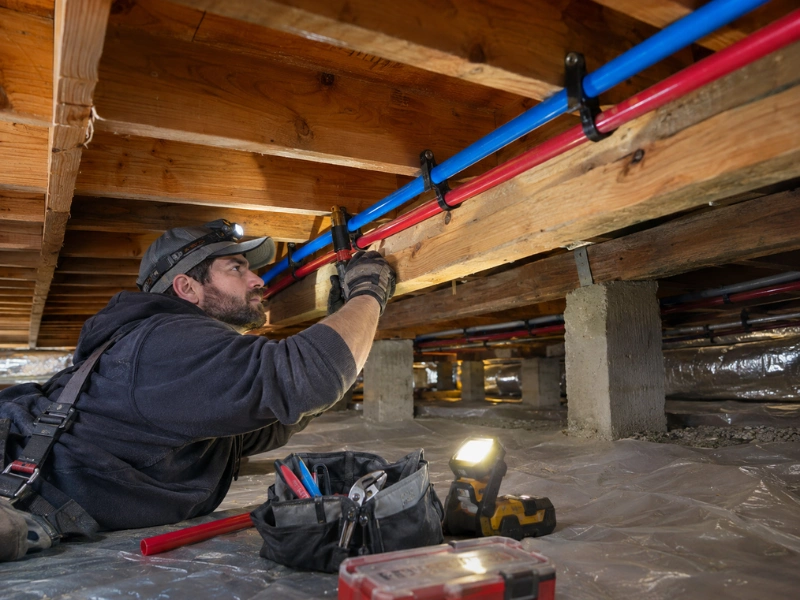
A PEX repipe is routed along the easiest hidden path from the water main to each fixture, usually through the crawlspace, basement ceiling or attic. Because PEX bends, it can follow that path in long runs with very few joints.
There are two common layouts:
Trunk and branch: one main line runs through the house, with smaller branches tapping off to each room
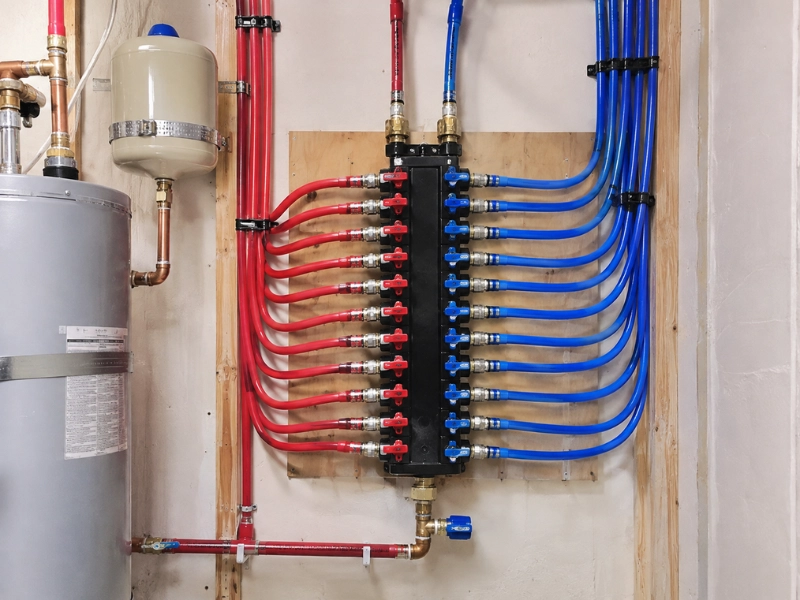
Home-run manifold: each fixture gets its own line from a central manifold, with a shutoff for every run
On Mercer Island, the house type often decides the route:
Ramblers with crawlspaces let us run most lines underneath, then come up through floors
Split-levels and daylight basements often use the basement ceiling as the main corridor
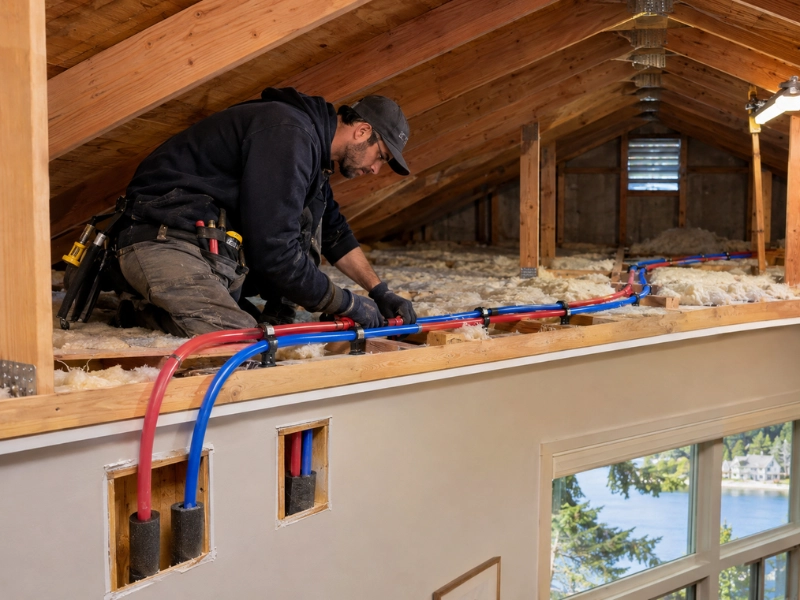
Slab-on-grade sections usually route through the attic and drop down inside walls
Waterfront and hillside homes may have long horizontal runs, so pipe supports and access points get extra planning
Where a line has to pass through a finished wall, we cut a small, neat opening rather than removing whole sheets of drywall. Then we patch those openings once inspection is complete. You can read more about the full process on our whole-house repiping page.
Which PEX fitting types hold up best inside walls?
Expansion and crimp fittings are the most common choices for a whole-house PEX repipe, because they make permanent, inspected joints. Push-fit fittings are better kept for repairs and accessible spots.
Each fitting type is built to its own standard, and the pipe type has to match:
Fitting type | How it seals | Standard | Best use |
Cold expansion | Pipe and ring expand over the fitting, then shrink back tight | ASTM F1960 | Whole-house PEX-A repipes |
Copper crimp ring | A copper ring is crimped over the pipe and barbed fitting | ASTM F1807 | PEX-B systems, repairs |
Stainless clamp (cinch) | A stainless band is clamped around the pipe | ASTM F2098 | Tight spaces, repairs |
Push-fit | Internal teeth and an O-ring grip the pipe | ASSE 1061 | Accessible repairs and transitions |
PEX fitting types aren't interchangeable across brands and pipe types without checking the manufacturer's instructions. As a result, mixing systems is one of the most common mistakes we see when fixing someone else's work. Whatever system is used, the joints are pressure-tested before any wall is closed.
For more on how pipe type affects the choice, our post on PEX repiping in Bellevue covers PEX-A and PEX-B in more detail.
What permits does a Mercer Island repipe need?
A whole-house repipe on Mercer Island needs a plumbing permit and a city inspection before walls are patched. The permit is pulled by the licensed plumbing contractor doing the work.
The city's single-family plumbing permit page explains that most residential plumbing permits can be obtained online through MyBuildingPermit.com. It also notes that many building permits are combination permits, so plumbing inspections may already be covered if the repipe is part of a larger remodel.
In practice, a permitted repipe usually involves:
A rough-in inspection with the new lines exposed and under test pressure
Confirmation of supports and protection where pipe passes through framing
A final inspection once fixtures are reconnected
There's one more detail worth knowing. When metal water pipe is removed, the home's electrical grounding may need attention, since some older systems used the water pipe as a ground path. We check that during the survey, so it doesn't turn into a surprise at the end.
How do you protect new PEX from sunlight, cold and pests?
You protect PEX by keeping it out of sunlight, insulating it in cold spaces and shielding it where rodents or sharp edges can reach it. These steps matter more than the pipe brand itself.
Here's what we pay attention to on Eastside jobs:
UV exposure: PEX shouldn't be left in direct sunlight, so exposed runs near crawlspace vents or garage windows get covered or sleeved
Cold crawlspaces and garages: pipe insulation helps prevent freezing during cold snaps, especially on exterior walls
Rodents: crawlspace runs are kept tight to framing, and vulnerable spots get protective sleeves
Heat sources: lines near the water heater follow the manufacturer's clearance rules, often with short metal connectors
Nail plates: steel plates protect pipe wherever it passes close to the face of a stud
PEX handles freezing better than copper because it can stretch a little. Still, it isn't freeze-proof. For seasonal steps, see our guide on how to winterize your plumbing system.
Where do we do PEX repipes near Mercer Island and Bellevue?
We handle PEX repiping in Mercer Island WA and across the Eastside, from our shop on NE 12th St in Bellevue. If you're comparing PEX repipe contractors near Mercer Island and Bellevue WA, our crews regularly work in:
Mercer Island, including the north end, First Hill and the south-end waterfront
Bellevue, Newcastle and Renton
Kirkland, Redmond, Issaquah and Sammamish
For homeowners in Sammamish, our post on PEX repipes in Sammamish covers what a repipe involves there.
Above all, a good PEX repipe is planned around your house, not just around the pipe. The right route, fittings and protection decide how well the system performs for decades to come.
Frequently asked questions
1. PEX or copper - which is the right call for this house?
For most homes here PEX is the right call, because it resists the corrosion that wears out copper and routes through finished walls with far fewer openings, while copper still suits exposed runs or owners who prefer metal. Weighing PEX against copper usually answers is PEX better than copper for a repipe, and for PEX or copper for repiping a Pacific Northwest home, PEX wins on cost and freeze tolerance in most houses.
2. How long should a PEX repipe last?
A properly installed PEX repipe is commonly expected to last 40 to 50 years or more under normal household conditions. The expected life of PEX depends mostly on installation, so anyone asking how long does PEX last should know that sunlight, heat near the water heater and mismatched fittings shorten it far more than age does.
3. Does PEX change how the water tastes?
Most people notice no change, though brand-new PEX can give off a faint plastic taste or smell for the first few weeks until the lines are well flushed. Anyone wondering does PEX affect water taste or quality can ask for pipe certified to NSF/ANSI 61, the drinking water standard that code-approved potable PEX must meet.
4. Why is a PEX repipe usually cheaper and faster?
PEX costs less per foot than copper and needs far fewer fittings, because it bends around corners and runs in long continuous lengths. That means smaller wall openings, no open-flame soldering and fewer joints to make, so crews finish most homes in fewer days.
5. Does PEX hurt resale on a high-value home?
No, PEX is common in new construction and approved under Washington's plumbing code, so buyers and inspectors generally see a full PEX repipe as an upgrade over aging copper or galvanized pipe. Keeping the permit records and fitting brand on file helps too, because a documented repipe answers inspection questions quickly.
Visit or Call Us
Eastside Repipe And Plumbing
Address: 12005 NE 12th St # 29, Bellevue, WA 98005
Phone: 425-331-2011
Email: [email protected]
Family-owned plumbing and repiping company
Serving Mercer Island, Bellevue, Kirkland, Redmond, Issaquah, Sammamish, Newcastle and Renton. Call for a free estimate, or use our contact page to book a visit.
