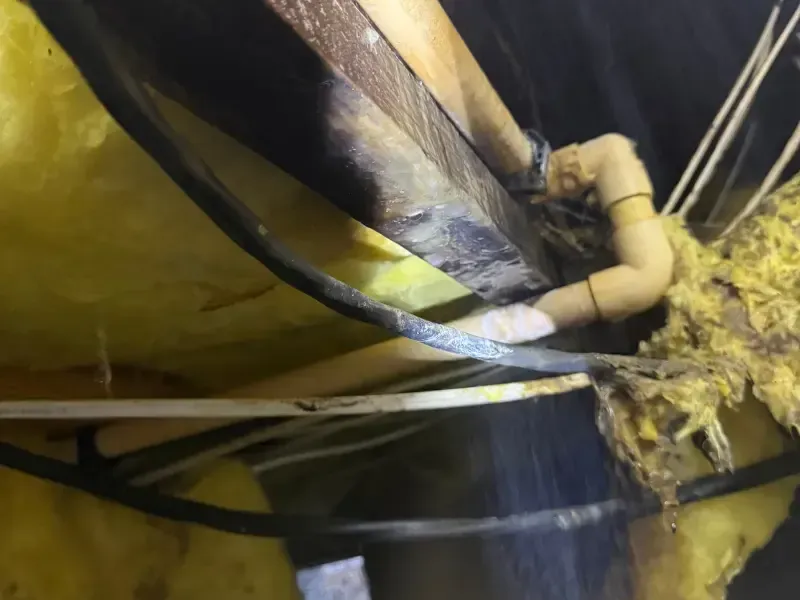
What Are the Signs Your Sewer Line Is Damaged in Redmond, WA?
The first signs of a failing sewer line are usually slow drains across multiple fixtures, gurgling, and smell — not a backup. Eastside Repipe and Plumbing handles sewer line repair in Redmond, WA, and where the damage sits relative to your property line changes the permit, the process, and the cost by thousands.
By Ramin Shahbaziasl, Owner and Lead Plumber · Last updated August 7, 2026
What Are the Signs Your Sewer Line Is Damaged?
One slow drain is a fixture problem. Several at once is a main line problem, and that distinction is the most useful diagnostic a homeowner has.
Call now. Sewage backing up into a floor drain, tub, or the lowest fixture in the house. Multiple fixtures backing up simultaneously. Water rising in a toilet when you run the washing machine.
This week. Slow drains in more than one fixture, particularly on the lowest level. Gurgling from a toilet or tub when another fixture drains — that is air being displaced through the trap because the line is partially blocked. Sewer smell indoors or near the foundation.
This month. A patch of lawn that is unusually green, lush, or wet with no irrigation explanation — a leaking line is fertilising it. Soft or sunken ground along the run between the house and the street. Recurring blockages in the same place, which almost always means a structural defect rather than what got flushed. Rodent activity, since a cracked line is an entry route.
The recurring-blockage one matters most. If a line has been cabled twice in two years, the problem is not the drain habits of the household. Something in the pipe is catching material, and cabling clears the symptom while leaving the cause.
Anything in the first tier is an emergency, and our emergency plumbing team is the right call rather than reading further — our emergency plumber guide covers what to do in the meantime.
What Causes Sewer Line Damage in Redmond?
The answer to what causes sewer line damage is mostly two things interacting: what the pipe is made of, and what is growing above it.

Clay pipe joins in bell-and-spigot sections, and every joint is a seam. Roots do not break into sound pipe; they find a joint that is already weeping and grow toward the moisture. Once inside, they thicken and catch everything that passes.
Orangeburg is the one to know about. It is a bituminised fibre pipe — essentially tar-impregnated wood pulp — installed widely from the mid-1940s into the early 1970s. It does not crack so much as deform, going oval under soil load until flow chokes and the pipe collapses. Homes in Redmond's older pockets built in that window may have it, and it has an expected life far shorter than clay or cast iron. If a camera shows an oval cross-section, you are looking at Orangeburg and the conversation is about replacement rather than repair.
Roots are the accelerant, and this is a genuinely Pacific Northwest problem. Big-leaf maple, willow, poplar, and cottonwood are the aggressive ones, and they are common along the Sammamish River corridor and the wetter low ground. Douglas fir and western red cedar contribute too on established lots. A mature tree within striking distance of the line is worth knowing about before you buy a house, not after.
Two more local factors. Redmond's low-lying ground near the river has a high seasonal water table, which affects both excavation and how a bellied line behaves. And ground movement from settlement or nearby construction separates joints in older pipe.

Where the Damage Sits Decides What It Costs
This is the part specific to Redmond, and it is the single most useful thing on this page for budgeting.
Redmond requires a permit for this work, and it is not the plumbing permit. On the City's utility permit page, Redmond states that all connections to the City sewer system require a side sewer application, and that repairs, terminations, and modification work on existing sewer service lines also require a side sewer permit. It also states that contractors must be active on the City's Side Sewer Contractor Roster.
That roster requirement is the fastest way to vet anyone quoting this work. If a contractor is not on Redmond's Side Sewer Contractor Roster, they cannot pull your permit, and you should find out before you sign rather than after they have dug a hole.
Then there is the property line, which splits the job into two different permits at very different fees. Per Redmond's published side sewer fee schedule under RMC 13.04.180, effective February 2025, a repair or disconnection permit runs $458.19, while a complex permit for work in the right-of-way runs $3,168.35. Redmond's guidance is explicit that any time sewer work extends beyond the private property line, a sewer complex permit is required.
So the same broken pipe costs materially different amounts depending on whether the defect sits twenty feet from your foundation or five feet past the property line under the sidewalk. That is before excavation, restoration, or traffic control in the right-of-way. It is why a camera inspection that locates and depth-marks the defect is not an upsell — it is what tells you which side of that line you are on before anyone quotes.
Two other provisions worth knowing from Redmond's wastewater code at RMC 13.04. Work must be inspected and pressure tested before the trench is backfilled, so nobody covers up a repair you have not seen signed off. And where a side sewer is shared between properties, a joint use agreement has to be recorded with King County — and if a shared line backs up in a way that causes an environmental or public health problem, the Public Works Director has authority to shut off water to every residence on that line, not just the one at fault. If you are on a shared side sewer, know who else is on it.
On the wider cost question, how much does sewer line repair cost is driven by depth, length, access, whether the defect is in the right-of-way, whether restoration involves driveway or street, and whether the method is trenchless or open-cut. Permit fees above are the City's published figures and are the one part anyone can quote you accurately in advance. We quote the rest after we have scoped the line, and camera inspections are how we do it.
Can Sewer Lines Be Repaired Trenchless in Redmond?
Often, and it is usually worth asking about before agreeing to open the yard.
Cured-in-place pipe lining pulls a resin-saturated liner through the existing pipe and cures it, forming a new pipe inside the old one. It needs a host pipe with continuous structure to line against, and it reduces the internal diameter slightly — rarely a problem on a six-inch line, occasionally one on a four-inch.
Pipe bursting pulls a bursting head through the old pipe, fracturing it outward while drawing new pipe in behind. It replaces rather than lines, and it can upsize. It needs a workable pull path and access pits at each end.
Trenchless does not solve everything, and an honest answer to whether trenchless sewer repair Eastside Seattle homeowners ask about will work depends on what the camera shows:
A belly — a sagging section holding standing water — is not fixed by lining. The liner follows the sag and preserves it. That section needs excavating and re-grading to the required fall.
A full collapse leaves nothing to line or burst through.
Severe offsets at joints can stop a liner or a bursting head.
Deformed Orangeburg is sometimes burstable and sometimes not.
Trenchless still requires the same side sewer permit and inspection, and it still needs access pits — it is less disruptive, not invisible. What it usually saves is the driveway, mature landscaping, and street restoration.
Repair or Replace?
Can a damaged sewer line be repaired rather than replaced? Frequently, and the camera decides it.
Spot repair makes sense where the line is sound overall and one defect is causing the problem — a single root intrusion at a joint, one cracked section, one offset. Excavate that section, replace a few feet, done.
Full replacement or lining makes sense where the defect is not a defect but a condition: root intrusion at multiple joints along the run, Orangeburg anywhere in the line, widespread cast iron section loss, or a line that has been cabled repeatedly. Spot-repairing a pipe whose whole length is at the same age and in the same soil buys you a year and the next call.
The test we use is simple: if the camera shows the same problem in more than two places, you are buying a series of repairs, and the total will exceed a replacement. Homeowners looking for the best sewer line repair near Redmond WA should expect to be shown the footage, not told about it.
Is Sewer Line Repair Covered by Insurance?
Usually not, and the reason matters.
Standard homeowners policies respond to sudden accidental damage and generally exclude wear and tear, gradual deterioration, and root intrusion — which covers the great majority of sewer line failures, since they are age and root problems by nature. A tree falling and crushing a line is a different case from a line that slowly filled with roots over fifteen years.
Two things are worth checking on your own policy. Many carriers offer a service line coverage endorsement that covers buried utility lines on your property, often for a modest annual premium, and it is the product actually designed for this. Separately, sewer backup coverage is its own endorsement and covers damage inside the home from a backup — which is not the same as paying to fix the pipe. Homeowners frequently have one and assume it is the other.
Check your declarations page before you need it. Adding a service line endorsement after a line fails does nothing.
Redmond Areas We Serve
Sewer work in Redmond varies less by neighbourhood than by two things: when the house was built, and what is growing near the line.
Southeast Redmond and the older central pockets — the pre-1970s stock, and where clay and Orangeburg are most likely.
Sammamish Valley and the low ground near the river — high seasonal water table, so excavation may need dewatering, and mature deciduous trees on the wetter ground are the aggressive root species.
North Redmond and Willows — mixed eras; often the question is whether an older line was replaced during a past remodel.
Newer developments across the city — ABS or PVC, so the failure modes are crushing, bellies from poor bedding, and construction damage rather than roots.
We work throughout the Eastside. Our Redmond page covers local service, and we also serve Kirkland, Bellevue, and Sammamish — sewer line contractors Bellevue area homeowners call are working under that city's own permit rules, which differ from Redmond's. The full list is on our locations page, broader work is on our general plumbing and specialized plumbing pages, and completed jobs are in our gallery.
Underground water problems are not always sewer problems — a wet spot can be a supply line, and our guides to slab leak repair and galvanized pipe replacement cover the supply side, with whole-system work on our repiping page.
If you have been searching sewer line repair Redmond WA, comparing emergency sewer repair plumbers in the Seattle Eastside, or wondering which contractor handles sewer repair in older Redmond homes, ask three questions: are you on Redmond's Side Sewer Contractor Roster, will you camera the line and show me the footage, and is the defect inside or outside my property line? Sewer line repair plumbers King County WA homeowners keep calling back are the ones who answer all three before quoting.

Frequently Asked Questions
1. What are signs my sewer line is damaged?
Slow drains in more than one fixture at once, rather than a single slow sink. Gurgling from a toilet or tub when another fixture drains, which is displaced air passing a partial blockage. Sewer smell indoors or near the foundation. A patch of lawn that is unusually green, lush, or soggy without irrigation. Soft or sunken ground along the line's run. And recurring blockages in the same spot, which almost always indicate a structural defect rather than what was flushed. Backups into the lowest fixtures are an emergency.
2. Can tree roots damage sewer lines in PNW?
Yes, and they are the leading cause of failure in older lines here. Roots do not break into sound pipe — they find a joint that is already weeping and grow toward the moisture, then thicken and catch debris. Clay pipe with bell-and-spigot joints is the most vulnerable. Big-leaf maple, willow, poplar, and cottonwood are the aggressive species, and they are common on the wetter low ground near the Sammamish River. Douglas fir and western red cedar contribute on established lots.
3. Is sewer line repair covered by homeowners insurance?
Usually not. Standard policies respond to sudden accidental damage and generally exclude wear and tear, gradual deterioration, and root intrusion — which is what causes most sewer line failures. Two endorsements are worth checking: service line coverage, which is designed for buried utility lines on your property and is often inexpensive, and sewer backup coverage, which pays for damage inside the home from a backup but not for repairing the pipe. Homeowners often have one and assume it covers the other. Add coverage before you need it.
4. How do I know if I need sewer repair vs replacement?
A camera inspection decides it. Spot repair works where the line is sound overall and one defect is causing the problem: a single root intrusion, one cracked section, one offset. Replacement or full-length lining is the right call where the same problem appears in multiple places, where any Orangeburg pipe is present, where cast iron shows widespread section loss, or where the line has been cabled repeatedly. If the camera shows the same defect in more than two places, a series of spot repairs will cost more than replacing the line.
5. Can sewer lines be repaired trenchless in Redmond?
Often. Cured-in-place lining forms a new pipe inside the existing one and needs a host pipe with continuous structure; pipe bursting fractures the old pipe outward while pulling new pipe in and can upsize the line. Neither works on a belly, since a liner follows the sag and preserves the standing water, and neither works on a full collapse. Severe joint offsets can stop both. Trenchless still requires Redmond's side sewer permit, inspection, and access pits — it is less disruptive rather than invisible.
Visit or Call Us
Eastside Repipe and Plumbing 12005 NE 12th St # 29 Bellevue, WA 98005 Phone: 425-331-2011 Hours: Monday–Sunday, 8:00 AM – 5:00 PM Serving Redmond and surrounding areas including North Redmond, Sammamish Valley, Southeast Redmond, and Willows, plus Kirkland, Bellevue, and Sammamish.
Drains slowing across the house? Request a free estimate or call 425-331-2011, and we will camera the line, show you the footage, and tell you which side of the property line the problem is on before we quote.
