Slab Leak Repair in Bellevue WA: What Does It Cost and How Does It Work?
A slab leak is a water line failure beneath the concrete foundation of your home. In Bellevue WA, left undetected, slab leaks cause an average of $10,000 or more in combined water and structural damage according to the Insurance Information Institute. Caught early, most are resolved within one to two days by a licensed plumber.
At Eastside Repipe and Plumbing, we have diagnosed and repaired slab leaks across Bellevue, Kirkland, Redmond, Issaquah, and the greater Seattle area for over 20 years. This guide covers every question Bellevue homeowners ask about slab leaks — what causes them, how to detect them, which repair method fits your situation, and what it actually costs.
What Is a Slab Leak?
A slab leak is a failure in a pressurized water supply line or drain line that runs beneath the concrete foundation of a home. In Bellevue, most slab-foundation homes built before 1990 use copper supply lines — the pipe type most susceptible to corrosion and abrasion. Water escaping under the slab saturates the soil, destabilizes the foundation, and damages flooring and framing long before any visible sign reaches the surface above. Slab leaks are particularly common in Bellevue's older neighborhoods — Crossroads, Eastgate, Somerset, and Newport Hills — where mid-century slab-on-grade construction and original copper plumbing are still the norm.
What Causes Slab Leaks?
The most common slab leak causes in Bellevue WA are copper pipe corrosion from local water chemistry, clay soil expansion from seasonal rainfall, and pipe abrasion from thermal expansion against concrete. Homes built before 1985 with original copper or galvanized lines carry the highest risk.
Six factors drive most slab leaks across the Eastside:
Seasonal soil movement. Bellevue's clay-heavy soils expand with winter rain and contract in summer, stressing embedded pipes.
Copper pipe corrosion. King County's slightly acidic water reacts with older copper pipe walls, thinning them from the inside out.
Pipe abrasion. Supply lines resting against concrete develop pinhole leaks at friction points over decades.
Hydrostatic pressure. Groundwater buildup beneath a slab during wet winters pushes against drain lines and forces joint failures.
Seismic activity. Western Washington's seismic activity shifts pipe connections under a slab over time.
Aging pipe materials. Most Bellevue homes built between 1950 and 1980 still have original supply lines — 40 to 70 years old and past their expected service life.
How Do You Detect a Slab Leak?
Professional slab leak detection uses a combination of pressure testing, electronic acoustic listening, and thermal imaging to pinpoint a leak beneath the concrete without cutting the slab. For a standard Bellevue home, the detection process takes two to four hours.
Eight Warning Signs to Watch For
You cannot see a slab leak directly, but your home gives clear signals. Watch for:
Warm or hot spots on the floor above hot water supply lines
Flooring that buckles, cracks, or separates from the subfloor
Unexplained spikes in your monthly water bill
The sound of running water when no fixtures are in use
Mold or mildew odor coming from floors or lower walls
Sudden drop in water pressure at multiple fixtures
Two or more of these signs together in your Bellevue home is a strong signal to call for professional leak detection immediately.
How Professional Slab Leak Detection Works
Pressure isolation test. The plumber pressurizes each supply line individually to confirm a leak and determine whether it is on the hot or cold side.
Electronic acoustic listening. Sensitive ground microphones amplify the sound of water escaping through concrete, narrowing the search area.
Thermal imaging scan. An infrared camera identifies heat anomalies in the floor surface caused by escaping hot water.
Findings report. The leak location is marked, documented, and repair options are presented before any work begins.
Best Slab Leak Repair Methods Compared
The best slab leak repair method for your Bellevue home depends on three things: where the leak is located, the overall condition of your pipe system, and how many failure points exist. One pinhole leak in an otherwise sound copper system calls for a very different response than a corroded system showing weakness at multiple points.
For most Bellevue homes with a single confirmed leak in an otherwise sound pipe system, pipe rerouting is the most practical solution. New supply lines run through walls and the attic, bypassing the slab entirely. No concrete is cut. The repair is permanent, less expensive than a full repipe, and completed in one day in most cases.
Spot repair (with a targeted slab cut) is appropriate when the leak is isolated and the pipe layout makes rerouting impractical. Epoxy pipe lining works well for small accessible leaks in long runs without cutting concrete. For homes built before 1980 where detection reveals widespread corrosion or multiple weak sections, whole-home PEX repiping eliminates the root cause rather than patching individual failures. See our PEX vs Copper Repiping Guide for a full material and cost comparison.
Slab Leak Repair Cost Estimate for Bellevue WA
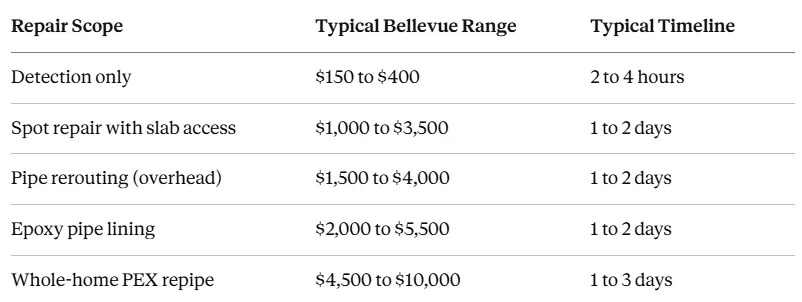
Slab leak repair in Bellevue WA typically runs $500 to $4,000 for a spot repair or pipe rerouting, and $4,500 to $10,000 for a whole-home PEX repipe when broader pipe system failure is confirmed. According to HomeAdvisor, the national average for slab leak repair ranges from $630 to $4,400 depending on method and access complexity.
Worked example: A 2,100 sq ft Bellevue home in Crossroads on a slab foundation with a single hot water line leak, detected electronically and repaired by rerouting the supply line through the attic and walls, typically runs $1,800 to $2,800 including detection, permit, labor, and pressure test.
Three factors move the cost most:
Leak location. Perimeter leaks are easier to access than those under load-bearing interior sections or tiled floors.
Pipe system condition. A single weak point costs far less to fix than a corroded system needing full replacement.
Repair method. Rerouting through walls is typically less expensive and more permanent than cutting into the slab.
Ready for an exact number for your home? Call us at 425-331-2011 or schedule a free walkthrough. Most Bellevue estimates are scheduled within 48 hours.
What to Expect During Slab Leak Repair in Bellevue
Most slab leak repairs in Bellevue take one to two days from the detection confirmation to the final pressure test, with water restored the same day in nearly every case.
Day 1: Detection Confirmation, Access, and New Lines
The crew arrives between 7:00 and 8:00 a.m., walks the home with you, and confirms the leak location. For pipe rerouting jobs — the most common repair in Bellevue slab homes — new supply lines run through interior walls and the attic with dust containment at every opening. Water is off for most of the workday. Before leaving, the system is pressure tested and water is restored to the home.
What you need to do: Clear access to the water heater and affected rooms. Move rugs and valuables away from work zones. Plan for water to be off for most of one workday. You do not need to leave the home.
Day 2 (if applicable): Larger Repairs and Inspection
Whole-home repipes may carry into a second day for final connections, pressure testing, and Washington state permit inspection sign-off. Access holes are patched before the crew leaves. The Washington State Department of Labor and Industries requires all plumbing contractors to hold a valid license. Eastside Repipe and Plumbing handles the full permit process on every job.
Does Homeowners Insurance Cover Slab Leak Repair in Bellevue?
Most Washington homeowners policies cover water damage from a sudden slab leak — flooring, drywall, mold remediation — but not the pipe repair itself. Coverage varies by policy. Document everything with photos before cleanup, and contact your insurer before repair work starts. The Washington State Office of the Insurance Commissioner handles coverage disputes.
Why Bellevue Homeowners Choose Eastside Repipe and Plumbing
Slab leak repair requires a licensed plumber who does this work regularly. Eastside Repipe and Plumbing has diagnosed and repaired slab leaks across Bellevue, Kirkland, Redmond, Issaquah, Sammamish, and Mercer Island for over 20 years. We do not subcontract — every technician is a direct employee trained specifically in slab leak detection and repair. Every job includes a free written estimate, a Washington state permit, a full pressure test, and same-day water restoration.
Learn more about our plumbing and repiping services, or read about signs your home may need a full repipe if your slab leak points to a broader pipe system issue.
Frequently Asked Questions
1. What is a slab leak?
A slab leak is a failure in a water supply or drain line beneath the concrete foundation of a home. Water under the slab erodes soil, damages flooring, and can crack the foundation. Most Bellevue slab leaks come from corroded copper pipes or clay soil movement from seasonal rainfall.
2. How do you detect a slab leak?
Licensed plumbers use pressure testing, electronic listening devices, and thermal imaging to locate leaks without cutting concrete. Detection takes two to four hours for a standard Bellevue home. Eastside Repipe and Plumbing provides detection across Bellevue and the greater Eastside.
3. What causes slab leaks in Bellevue WA?
Copper pipe corrosion from King County's slightly acidic water, clay soil expansion from Pacific Northwest rainfall, and pipe abrasion from thermal expansion rubbing against concrete. Homes built before 1985 with original copper lines carry the highest risk.
4. How long does slab leak repair take?
One to two days for most jobs, with water restored the same day. Pipe rerouting typically finishes in one day. Whole-home repipes may take two to three days.
5. How much does slab leak repair cost in Bellevue WA?
Spot repair or rerouting runs $500 to $4,000. Whole-home repiping runs $4,500 to $10,000 when broader pipe failure is confirmed. Call 425-331-2011 for a free on-site estimate.
6. What is the best slab leak repair method?
It depends on pipe condition. A single pinhole leak in a sound system calls for rerouting. A corroded system with multiple weak points calls for whole-home repiping. Eastside Repipe and Plumbing assesses each home before recommending a method.
7. Does homeowners insurance cover slab leak repair?
Most Washington policies cover water damage from a slab leak but not the pipe repair itself. Document damage with photos before cleanup and notify your insurer before repair begins. The Washington State Office of the Insurance Commissioner handles coverage disputes.
8. Do I need a permit for slab leak repair in Bellevue?
Yes, for significant plumbing repairs and whole-home repiping. Washington requires a permit pulled by a licensed contractor followed by a city inspection. Eastside Repipe and Plumbing handles the full permit process on every job.
Ready to Fix Your Slab Leak in Bellevue?
A slab leak caught early is a one-to-two day repair. Left to run, it becomes a foundation problem. Eastside Repipe and Plumbing has been solving this for Bellevue, Kirkland, Redmond, Issaquah, and Mercer Island homeowners for over 20 years — licensed technicians, no subcontracting, same-day water restoration, written estimate before work begins.
Schedule your free walkthrough or call 425-331-2011. We confirm the leak, walk you through your options, and give you a clear written estimate before anything gets started.
By Ramin Shahbaziasl, Licensed Plumbing Contractor | Eastside Repipe and Plumbing, Bellevue, WA | 20+ Years Experience
Sources
Insurance Information Institute — https://www.iii.org/article/water-damage-and-sewage-backup
HomeAdvisor — https://www.homeadvisor.com/cost/plumbing/fix-a-slab-leak/
Washington State Department of Labor and Industries — https://lni.wa.gov/licensing-permits/contractors/hire-a-contractor/
Washington State Office of the Insurance Commissioner — https://www.insurance.wa.gov
