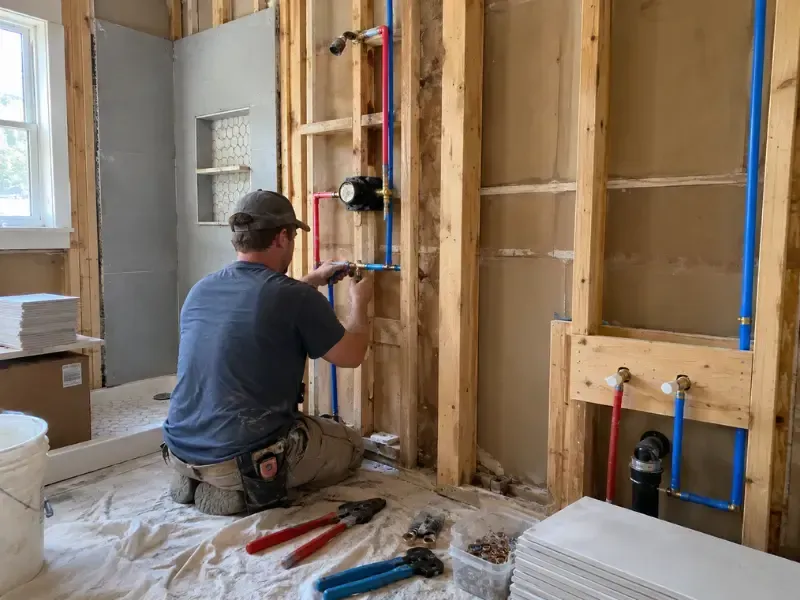
How Does Repiping with PEX Work in Sammamish, WA?
Replacing the water supply lines throughout a house with cross-linked polyethylene tubing instead of copper or galvanised steel. Straightforward enough — except PEX isn't one product, and the choice that matters most isn't the tubing at all. It's the fittings.
By Ramin Shahbaziasl, Owner and Lead Plumber · Last updated September 9, 2026
What Does Repiping with PEX Involve?
Repiping with PEX means taking out the existing supply piping — hot and cold, from the service entry to every fixture — and running cross-linked polyethylene in its place. Drains and waste aren't part of it.
What are the benefits of repiping with PEX? It's the default for whole-house work because of installation rather than the material — a pex whole house repipe opens far less of the building than copper does. PEX runs in long continuous lengths and bends around corners where copper needs an elbow, so a repipe using pex involves far fewer joints and much less demolition. That shows up directly in the restoration bill, which is usually the larger half of the total.
Two layouts exist. Trunk and branch mimics the old copper arrangement. Home run manifold gives each fixture a dedicated line to a central manifold — more tubing and labour, better isolation, steadier pressure.
Cost sits in our Washington repiping cost guide, and whether your house needs it at all is in our Sammamish repiping guide — most plateau homes are newer than people assume and don't.
Which PEX Type Should You Use?
Here's what almost nobody explains. PEX comes in three types, distinguished by how the polyethylene is cross-linked.
Type | Method | Character | Fittings |
PEX-A | Peroxide | Most flexible, kinks can be heat-repaired | Cold expansion, or insert |
PEX-B | Silane | Stiffer, coil memory, higher burst pressure | Crimp, clamp, or insert |
PEX-C | Electron beam | Stiffest, least forgiving of kinks | Crimp or clamp |
The important part: all three meet the same standards. ASTM F876 governs the tubing regardless of crosslinking method, and every type sold for potable water here complies with it and with SDR9. The differences are about handling and installation, not permissibility.
PEX-A's flexibility means fewer fittings on a complex run and a kink rescued with a heat gun rather than cut out. PEX-B is stiffer and costs less. Both are used in serious whole-house work daily. If a pex repipe specialist Sammamish Washington homeowners consider can't say which type they install and why, note that.
What Does the PEX Repiping Process Look Like?
How does repiping with PEX work, day by day? The pex repiping process runs in five stages, and knowing them makes the disruption predictable.
One — walkthrough and layout. Map every fixture, choose trunk-and-branch or manifold, agree where openings go, confirm PEX type and fitting system.
Two — access. Openings cut in drywall and ceilings at planned points rather than convenient ones. Fewer, better-placed openings mean less restoration — where a careful layout earns its money.
Three — run the new lines. New PEX pulled through walls, floors and crawlspace to every fixture, old pipe left live until the new system is ready. That's deliberate — it keeps you on water longer.
Four — tie in, pressure test, changeover. New system connected at the service entry and at each fixture, pressure tested before anything is closed up, then the old lines cut out and capped. Water is off for part of a working day rather than for days.
Five — restoration. Patch, tape, texture to match, prime, paint. Longest stage on the calendar and the one thin quotes leave out.
Most Sammamish homes go through stages one to four in one to two days. Restoration follows.

Why Do the Fittings Matter More Than the Pipe?
Because tubing rarely fails mid-run. Joints fail.
Three systems dominate. Cold expansion stretches tubing and a ring over the fitting and lets it shrink back, so nothing narrows the bore. Crimp and clamp use an insert fitting with a copper ring or stainless cinch — proven and cheap, though the insert narrows the bore at each joint. Push-fit is fast and useful for repairs, and few plumbers want dozens buried in walls.
Two consequences. Systems are engineered together — ASTM F877 covers complete PEX systems including fittings, manifolds and installation practice rather than tubing alone, so mixing brands outside what the manufacturer approves is where warranty problems begin. And bore reduction accumulates, which matters on a trunk-and-branch layout in a house with marginal pressure already.
Why Does Chlorine Matter More Than Hardness Here?
This is the Sammamish-specific part, and it's the opposite of what you'd expect.
Hardness is the local story for copper and fixtures — the District blends medium-hard groundwater with softer regional supply at around 3 to 6.5 grains, and scale wears out cartridges and water heaters. Our general plumbing guide covers it.
PEX doesn't care about hardness. Scale doesn't adhere to it the way it does to metal. What PEX cares about is chlorine — the District chlorinates its groundwater, and free chlorine in hot water oxidises polyethylene over time.
The standards address it directly. ASTM F876 requires tubing to be tested for oxidative stability in chlorinated potable water using the ASTM F2023 method, with a minimum extrapolated lifetime of 50 years to qualify for potable use. Testing runs at 4 ppm free chlorine, matching the EPA's maximum permitted residual, at elevated temperature.
So chlorinated water is designed for rather than overlooked. What matters is buying tubing with the certification imprint, and knowing recirculating hot systems run hotter for longer. F876 also requires UV testing, so tubing shouldn't sit in sun and exposed runs need protecting.
Why Is Certified PEX Safe for Drinking Water?
Yes, when it's certified — and the certification is something you can check on the pipe itself.
Two standards matter. NSF/ANSI 61 covers health effects: it requires analysis of anything leaching into water plus a toxicological evaluation confirming concentrations sit below levels of health concern, tests across differing pH, temperature and hardness, evaluates complete systems including fittings, and includes a taste and odour evaluation. NSF/ANSI 372 covers lead content under the federal Safe Drinking Water Act, and matters most for brass fittings rather than tubing.
PEX contains no lead. BPA is associated with other plastics rather than cross-linked polyethylene.
Now the honest part. New PEX can give a faint plastic taste on the first draws. Trace organic compounds leach initially and diminish, and certified tubing has to pass that taste-and-odour test at all. Flushing a new system before drinking is standard practice on any new plumbing, not a PEX workaround. If a taste persists past the first weeks, tell us which taps and whether it's hot or cold — that narrows it to a branch rather than the material.
The practical safeguard is buying certified product: the certification marks are printed on the tubing, and unmarked pipe is the thing to avoid.
How Long Does It Take, and Is It Worth It?
A pex pipe replacement across a whole house is typically one to two days of plumbing for most Sammamish homes, then drywall repair, texture and paint — finishing usually takes more calendar than pipework. You keep water throughout. Two storeys, more than two bathrooms and slab-on-grade all extend it, since access drives the schedule more than square footage.
Is repiping with PEX worth it? On a failing system, yes — the case rests on fewer joints, less demolition and lower restoration cost rather than the tubing being magic. On a sound system it isn't worth it yet, whatever anyone tells you.
On warranties, manufacturers cover tubing for decades subject to three conditions: approved fittings, since the standards cover systems rather than tubing alone; correct tools and technique, with some requiring installer certification; and material rather than labour. A manufacturer warranty replaces defective tubing — it won't pay to open walls and restore finishes. That's the installer's workmanship warranty, and it's the half that costs money. [CONFIRM: Eastside's workmanship warranty term.]
On pex vs copper repipe: not a universal answer, and Sammamish is a place where copper remains legitimate because the water isn't aggressive toward it. Our live PEX versus copper guide sets out the full comparison.
We cover Sammamish including Pine Lake, Klahanie, Sahalee and Inglewood, plus Issaquah, Redmond and Bellevue. The service sits on our repiping page, routine work on general plumbing, the area list on our locations page, and finished jobs in the gallery.
Searching repiping with pex near me Sammamish WA, pex repipe near me Sammamish WA, or for a pex repiping service Sammamish Washington homeowners trust? Ask which PEX type, which fitting system, and what the workmanship warranty covers. And if you want to repipe with pex near Sammamish, ask to see the certification imprint on the tubing.

Frequently Asked Questions
1. Why choose PEX for repiping?
The case is installation rather than the tubing being superior outright. PEX runs in long continuous lengths and bends where copper needs a soldered elbow, so a whole-house repipe means far fewer joints and much less wall opened up — and since restoration is normally the larger half of the bill, that's where the saving lands. PEX also resists the scale hard water leaves on metal, and tolerates a freeze better than rigid pipe.
2. How much does repiping with PEX cost in Sammamish?
How much does a PEX repipe cost in Sammamish? Fixture count, number of bathrooms, storeys, access, layout, and the standard of restoration afterwards. Crawlspace homes cost less than slab-on-grade because far less wall and ceiling needs opening. A home-run manifold uses more tubing and labour than trunk-and-branch but gives better isolation and steadier pressure. The variable that catches people is restoration — drywall repair, texture matching and paint — so confirm whether a quote includes it, since one that stops at the pipe isn't comparable to one that doesn't.
3. How does the PEX repiping process work?
Five stages. A walkthrough to map fixtures, choose the layout and agree where openings go. Cutting those openings at planned points, since fewer and better-placed ones mean less restoration. Running new lines to every fixture while the old pipe stays live. Tying in, pressure testing before anything closes up, then cutting out the old lines — water off for part of a working day, not days. Then restoration: patch, tape, texture, prime, paint.
4. Is PEX safe for drinking water?
Yes, when certified, and you can check it on the pipe. NSF/ANSI 61 covers health effects — analysis of anything leaching into water plus a toxicological evaluation confirming concentrations sit below levels of health concern, tested across varying pH and temperature, covering fittings as well as tubing, and including a taste and odour evaluation. NSF/ANSI 372 covers lead content under the Safe Drinking Water Act, mattering most for brass fittings. New PEX can give a faint plastic taste on first draws that fades; flush before drinking, as with any new plumbing.
5. How long does repiping with PEX last?
The standards set a floor rather than a guess: ASTM F876 requires potable PEX to demonstrate a minimum extrapolated 50-year lifetime when tested for oxidative stability in chlorinated water under ASTM F2023, at 4 ppm free chlorine and elevated temperature. In practice the connections and water conditions decide the outcome more than the tubing — correct fittings made with the right tool, tubing protected from UV, and recirculating hot systems treated as the harder duty.
Visit or Call Us
Eastside Repipe and Plumbing 12005 NE 12th St # 29 Bellevue, WA 98005 Phone: 425-331-2011 Hours: Monday–Sunday, 8:00 AM – 5:00 PM Serving Sammamish including Pine Lake, Klahanie, Sahalee, and Inglewood, plus Issaquah, Redmond, Bellevue, and the Eastside.
Weighing up materials? Request a free estimate or call 425-331-2011, and we'll tell you which PEX type and fitting system we'd use on your house, and why.
