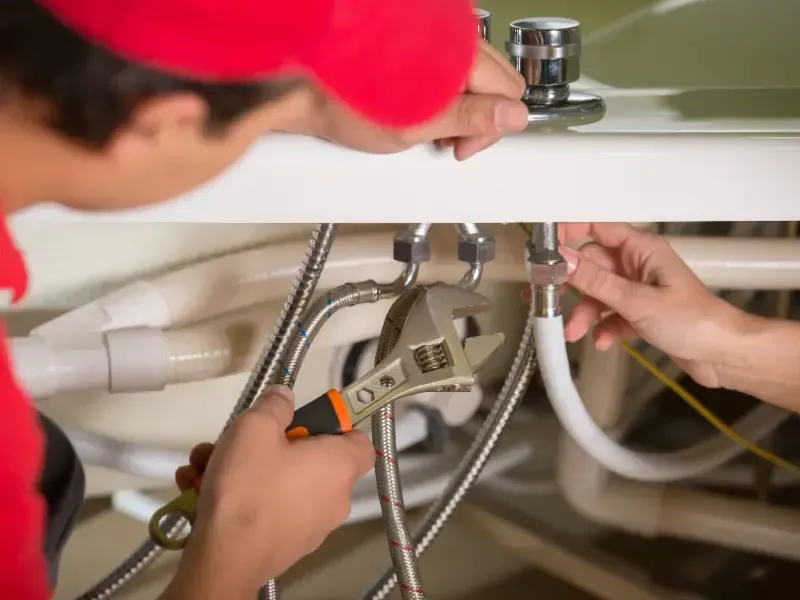
24/7 Emergency Plumbing Redmond WA: What Counts as an Emergency?
A plumbing emergency is anything actively releasing water, sewage, or gas into your home, or removing your ability to use water at all. Eastside Repipe and Plumbing takes emergency calls across Redmond, WA, and the first thing worth knowing is where your main shutoff is before you ever need it.
By Ramin Shahbaziasl, Owner and Lead Plumber · Last updated August 10, 2026
What Counts as a Plumbing Emergency?
Asking what is considered a plumbing emergency is really asking what justifies paying after-hours rates. The honest test is whether waiting until morning makes the damage worse or the house unusable.
Genuine emergencies — call now:
A burst or actively leaking supply line, anywhere.
Sewage backing up into the house, from any fixture.
No water at all, when the City's system is working.
A water heater leaking from the tank body rather than a fitting.
Any smell of gas.
Water near electrical panels, outlets, or the furnace.
A shutoff valve that will not close while water is escaping.
Not emergencies — book normal hours and save the premium:
A dripping tap or a running toilet. Unpleasant and wasteful, but contained.
One slow drain, with the other fixtures draining normally.
A single fixture out of service in a house with others.
Low pressure that has been low for months.
A water heater running cool without leaking.
That second list matters as much as the first. Emergency response exists to stop damage in progress, and there is nothing to stop when the problem is contained and inconvenient. A plumber who tells you a running toilet needs a midnight visit is selling you something.
So when should I call an emergency plumber comes down to three questions: is water or sewage escaping, can I stop it myself at a valve, and is anything electrical involved. Yes, no, or yes to any of those and it is a call now.
What to Do in the First Five Minutes
The single most useful thing on this page. Do these in order.
One: shut the water off. Find your main shutoff and close it. In most Redmond homes it is where the service line enters — often in the crawlspace near the front of the house, sometimes in a garage or utility room. If you cannot find it or it will not turn, the City can assist with an emergency shut-off at the meter; that is in the next section.
Two: kill the power if water is near anything electrical. If water is reaching outlets, a panel, a furnace, or a water heater's electrical connection, switch the relevant breaker off — from a dry position. If you cannot reach the panel without standing in water, do not. Call 911.
Three: if you smell gas, leave. Do not operate light switches, do not use a phone indoors, do not look for the source. Get everyone out, then call 911 and your gas utility from outside.
Four: open the lowest fixtures. Once the main is closed, opening taps at the lowest point in the house drains the remaining pressurised water downward and away from the leak rather than out of it.
Five: contain and document. Towels and buckets, move what you can, then photograph everything before you clean up. Insurance claims turn on documentation, and the state of the room ten minutes after the event is what an adjuster wants to see.
Six: then call. Tell us what you shut off, what you can see, and whether the water has stopped. That determines whether we roll immediately or schedule you first thing.
For emergencies on a slab rather than a crawlspace, where the leak is under concrete rather than visible, our guide to slab leak repair covers the diagnostics.

Which Number to Call: Yours, the City's, or 911
Here is the Redmond-specific part, and it saves both money and time.
Not every plumbing emergency is your problem to pay for, and the dividing line is the water meter. The City of Redmond states plainly that it is responsible for fixing leaks from the water main up to and including the meter, and that any leak between the meter and your home or business is the owner's responsibility. Property owners maintain and repair the service line from the meter to the building.
That gives you a triage rule. Water surfacing in the street or at the meter box is a City call. Water surfacing in your yard between the meter and the house is a plumber call. A sewer backup could be either — a blockage in the City main is theirs, a blockage in your side sewer is yours, and the City will check its main to determine which.

Two numbers worth putting in your phone now. Redmond's utility offices run Monday to Friday, 8 a.m. to 5 p.m., and for assistance outside those hours the City directs residents to its after-hours emergency line on 425-556-2500. And the City's water operations team explicitly offers help locating your meter and performing an emergency water shut-off, which is the call to make when your own valve has seized — details on the City's drinking water operations page.
For anything involving gas, fire risk, or water reaching electrical equipment, 911 comes before either.
Frozen Pipes: Follow the City's Own Guidance
Puget Sound freezes are occasional rather than annual, which is exactly why they cause so much damage here — most homes are not prepared and most exposed pipe is in a vented crawlspace. Higher ground around Education Hill and the northern parts of the city tends to see it first; the low ground through the Sammamish Valley holds cold air.
Redmond publishes its own thaw protocol in the City's water FAQs, and it is worth following rather than improvising. Shut the water off at the main shutoff valve and open the tap nearest the frozen section so it can drain as it thaws. Warm the pipe gradually, working from the tap toward the frozen area rather than the other way round — a hair dryer for accessible pipe, a heat lamp held at least eight inches away for pipe behind walls, floors, or ceilings. Rags and hot water if nothing else is available.
And the warning the City puts in bold, which we will repeat: never use an open flame. It heats the pipe too quickly and can split it, and there is a real fire risk in a crawlspace full of dry insulation and vapour barrier.
If a frozen pipe has already burst, the sequence in the previous section applies — main off first, then call.
How Much More Do Emergency Plumbers Cost?
Straightforwardly, more. How much does emergency plumbing cost depends on the hour, the day, and what the job turns out to be, but the structure is consistent across the trade: after-hours work carries a premium over the same work booked in normal hours, because it means a crew mobilising outside a scheduled day.
Three things that actually move the number. The time you call — late evening costs less to serve than three in the morning. Whether the water is already off, because a stopped leak lets us diagnose calmly rather than working against a live flow. And what the failure turns out to be, since a burst supply line at an accessible fitting is a different job from one inside a wall or under a slab.
Worth knowing: the City charges its own after-hours fee for utility work, currently an additional charge for services turned on outside office hours, so premiums for out-of-hours response are not unique to private contractors.
What we would rather do is help you avoid the premium entirely. If you call and describe something that is genuinely contained, we will tell you it can wait until morning and book you then. That conversation costs us the emergency rate and earns the next five jobs.
Can Plumbing Emergencies Be Prevented?
Most of them, and the preventive work is unglamorous.
Do the shutoff drill. Find your main shutoff today, turn it fully off and back on, and make sure everyone in the house knows where it is. A valve that has not moved in fifteen years often will not move when you need it, and discovering that during a burst is the worst possible time. If it will not turn, replacing it is a scheduled job at normal rates.
Run the meter test. The City points out that many meters have a sweeping hand or triangle that moves whenever water is flowing. Turn everything off inside and out, then look at the meter: if that indicator is moving, you have a leak somewhere. Thirty seconds, no tools, and it catches slow failures before they become fast ones.
Replace braided supply lines on a schedule. Washing machine and toilet supply lines fail at the crimp, and they fail suddenly. They are inexpensive and nobody replaces them until one lets go.
Insulate the crawlspace and exterior pipe before winter, disconnect hoses from hose bibs in autumn, and know which fixtures sit on exterior walls.
Take repeat problems seriously. A drain that blocks twice in two years, or a supply line that has had a pinhole leak, is telling you something about the rest of the system. Our guides to galvanized pipe replacement and repiping cover when that becomes a whole-system conversation rather than a repair.
Redmond Areas and Response
Anyone asking which plumber responds fastest in Redmond WA at night is asking a fair question, and the honest answer is that it depends on geography and the hour rather than on marketing. It is worth being realistic rather than promising numbers nobody can keep.
Overlake and southern Redmond — closest to our Bellevue base, so typically the fastest.
Downtown Redmond and Education Hill — straightforward access off the main arterials.
Bear Creek, Union Hill, and the eastern edge — longer runs, particularly at night.
Sammamish Valley and low-lying areas — where freeze events and standing water complicate access.
We cover Redmond along with Kirkland, Bellevue, and Sammamish — a weekend plumber Bellevue area residents call is the same crew covering Redmond, and an emergency plumber King County WA homeowners reach after hours is usually the same operation working across city lines. Details are on our emergency service page, our Seattle emergency plumber guide covers 24 hour plumbing Eastside Seattle residents may need on the city side, and the full area list is on our locations page. Scheduled work sits on our general plumbing and specialized plumbing pages.
Compare the best 24 hour plumbers in the Seattle Eastside on a calm afternoon rather than mid-flood, because the filter is simple and takes one phone call: ask whether the person answering dispatches a crew or takes a message. Searching for a 24/7 emergency plumber near Redmond WA at the moment water is coming through a ceiling means taking whoever answers first.
If you are searching 24/7 emergency plumbing Redmond WA at two in the morning, do not read further — shut the water off and call. If you are reading this on a calm afternoon, go and find your main shutoff. That is the whole point of the page.

Frequently Asked Questions
1. What counts as a plumbing emergency?
Anything actively releasing water, sewage, or gas, or leaving the house without water. That means burst or actively leaking supply lines, sewage backing up into fixtures, no water at all when the City's system is working, a water heater leaking from the tank body, any gas smell, water reaching electrical equipment, and a shutoff valve that will not close while water escapes. A dripping tap, a running toilet, one slow drain among several working ones, or a water heater running cool without leaking are not emergencies and should be booked in normal hours.
2. How much more do emergency plumbers cost?
After-hours work carries a premium over the same job booked during normal hours, because it means mobilising outside a scheduled day. The size of the premium depends on the hour and the day, whether the water is already shut off when we arrive, and what the failure turns out to be. The City of Redmond applies its own after-hours charge for utility work, so out-of-hours premiums are standard rather than unique to private contractors. If what you describe can safely wait until morning, we will tell you so.
3. Can plumbing emergencies be prevented?
Most can. Locate your main shutoff and exercise it so it will actually turn when needed, and make sure the whole household knows where it is. Use the meter test — with all water off, a moving indicator on the meter means a leak. Replace braided washing machine and toilet supply lines on a schedule rather than after one fails. Insulate crawlspace and exterior piping before winter and disconnect hoses from hose bibs in autumn. And treat repeat blockages or pinhole leaks as a signal about the wider system.
4. What should I do while waiting for an emergency plumber?
Shut the water off at the main. If water is near outlets, a panel, a furnace, or a water heater's electrical connection, switch off the relevant breaker from a dry position — and if you cannot reach the panel without standing in water, call 911 instead. If you smell gas, leave the building without touching switches and call 911 and your gas utility from outside. Then open the lowest taps in the house to drain remaining pressure downward, contain what you can with towels and buckets, and photograph everything before cleaning up for insurance purposes.
5. Do emergency plumbers come on weekends and holidays?
Emergency plumbing is by definition outside normal scheduling, so weekend and holiday response is part of the service — and holidays are among the busiest periods, because more people are home using water and freezes tend to land over long weekends. What varies between companies is honesty about response times. Ask what the realistic window is for your address at the hour you are calling rather than accepting a general promise, and ask whether the person answering is dispatching an actual crew or taking a message.
Visit or Call Us
Eastside Repipe and Plumbing 12005 NE 12th St # 29 Bellevue, WA 98005 Emergency line: 425-331-2011 Serving Redmond and surrounding areas including Education Hill, Overlake, Bear Creek, and the Sammamish Valley, plus Kirkland, Bellevue, and Sammamish.
Water coming in right now? Shut the main off, then call 425-331-2011. If it can wait until morning, we will say so and book you at normal rates.
