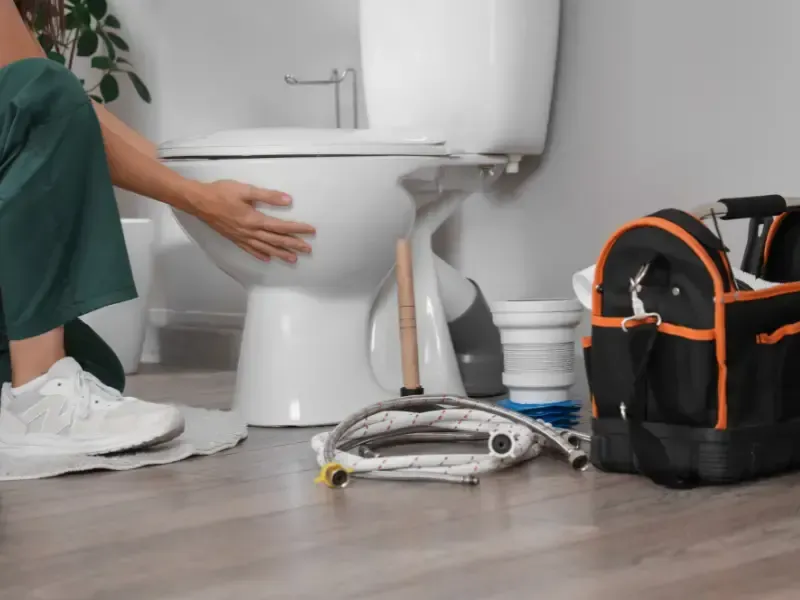
What Should You Know Before Toilet Installation in Kirkland, WA?
Most toilet installations take one to two hours, but the part that decides whether it goes smoothly happens before anyone picks up a wrench: measuring the rough-in and confirming the flange height. Eastside Repipe and Plumbing handles toilet installation in Kirkland, WA, and Washington code sets a stricter flush limit than federal law does.
By Ramin Shahbaziasl, Owner and Lead Plumber · Last updated August 4, 2026
What Is the Best Type of Toilet?
Homeowners ask what is the best type of toilet, and the honest answer is that no single model wins for everyone — but there is a best type for your bathroom, and the choice comes down to four things: how the flush is powered, how tall the bowl sits, how the trap is concealed, and where the bathroom sits relative to your sewer line.

If you are working out how to choose a new toilet, ignore styling for a moment and start with bowl height. Standard bowls sit around fifteen inches to the rim; a comfort height toilet setup sits roughly seventeen to nineteen inches, which most adults find easier to stand up from and which matches standard chair height. It is the single upgrade homeowners most often tell us they should have made sooner. It is not automatically better for everyone, though — shorter adults and small children are more comfortable on a standard bowl, so in a family bathroom the standard height is often the right call.
On brands: searches for the best toilet brands 2026 will hand you affiliate lists that change with commission rates. A more reliable filter is the MaP score, short for Maximum Performance, which measures how many grams of solid waste a toilet clears in a single flush. Anything rated at 600 grams or better will not disappoint you regardless of the badge on the tank, and that number is published independently of the manufacturer.
Measure Your Rough-In Before You Buy Anything
This is the one piece of homework worth doing yourself, and it is the reason a good share of our toilet replacement install calls start with a return trip to the store.
The rough-in is the distance from the finished wall behind the toilet to the centre of the closet bolts holding it down. It comes in three sizes: twelve inches, which covers the large majority of homes; ten inches, common in older or space-constrained bathrooms; and fourteen inches, which shows up occasionally. Measure it before you buy. A twelve-inch toilet will not sit properly on a ten-inch rough-in, and no amount of persuasion at installation time changes that.
Two more measurements save trouble. Check the clearance from the centre of the drain to each side wall or vanity, because a wider skirted base can foul a cabinet that the old narrow base cleared. And check the bowl shape you have room for — elongated bowls are more comfortable but project a couple of inches further into the room than round-front bowls, which matters in a small Kirkland powder room with a door that swings inward.
We are glad to install a fixture you supplied; most of our new toilet install service work is on homeowner-purchased toilets. We would just rather you buy the one that fits.

What Washington's 1.28-Gallon Rule Means for Your New Toilet
Here is where Washington differs from most of the country, and it is worth knowing before you shop.
Federal law has capped new residential toilets at 1.6 gallons per flush since 1994. Washington goes further. Under the state's adopted plumbing code at WAC 51-56-0400, the effective flush volume of all water closets must not exceed 1.28 gallons per flush, and installed water closets must meet or exceed the minimum performance criteria developed for high-efficiency toilet certification under the EPA's WaterSense program.
Read that carefully, because it reframes the question. In Washington, a high-efficiency toilet is not an eco upgrade you opt into — 1.28 gallons is the ceiling, and WaterSense-level performance is written into the code itself. Anyone selling you a 1.6-gallon model as the standard option is working from the federal rule, not the one that applies here.
The good news is that the old objection no longer holds. The EPA notes on its residential toilets page that the low-flow toilets of the 1990s earned a reputation for double flushing and poor satisfaction, and that design improvements since then let modern toilets use 1.28 gallons or less while delivering equal or better performance. It also points out that toilets account for nearly thirty percent of the average home's indoor water use, and that older fixtures using up to six gallons a flush are a major source of waste — which is why replacing a pre-1994 toilet in an older Kirkland home shows up on the water bill.
One thing the code does not require: a WaterSense label. It requires the performance. A labelled model is the simplest way to be confident you have met it.
What Kirkland Homes Do to a Toilet Installation
Four local conditions account for most of the surprises we run into, and none of them are visible when you buy the fixture.
Flange height in older homes. In pre-1980 houses around Everest, Evergreen Hill, and the older parts of Central Houghton, bathroom floors have often been built up over the decades — vinyl, then tile over backer board, sometimes twice. Every layer raises the finished floor while the closet flange stays where it was. A flange sitting below finished floor level is the leading cause of a brand-new toilet that rocks, weeps at the base, or loosens after a month. The fix is an extender ring properly stacked and sealed, not a second wax ring piled on the first. If someone offers you the second-wax-ring approach, decline.
Cast-iron closet bends. Older Kirkland homes still have cast-iron drainage below the bathroom, and a flange rusted into or onto cast iron does not simply unbolt. Sometimes it cuts out cleanly; sometimes the top of the bend has corroded thin and the repair grows. We check this before quoting rather than discovering it with your bathroom out of service, and where the wider drainage system is at end of life our galvanized pipe replacement guide covers what that conversation looks like.
Bathrooms below the sewer line. Kirkland's terrain drops steeply toward Lake Washington, and daylight basements are common on those slopes. If a basement bathroom sits below the level of the sewer main in the street, gravity will not move waste uphill and a standard toilet is the wrong fixture — you need an upflush or macerating system, or a sewage ejector pit. This is the single most common reason a basement bathroom project stalls, and it is a design question rather than an installation question.
High supply pressure, and why it does not help the flush. Elevated water pressure in parts of Kirkland is a real issue this year, and it is worth being precise about what it does and does not affect. A gravity toilet's flush energy comes from the height of water in the tank, not from the pressure in the supply line, so high pressure will not improve a weak flush. What it does do is shorten the life of the fill valve and the supply connector, and it makes water hammer more likely when the valve snaps shut. We cover the pressure situation and pressure-reducing valves in detail in our guide to faucet repair in Kirkland. For the opposite problem — genuinely low pressure or a chronically weak flush on an upper floor — pressure-assist is the fixture answer.
How Much Toilet Installation Costs and How Long It Takes
Taking the money question first, how much does toilet installation cost depends on whether we are swapping like for like or solving something. A straightforward replacement — remove the old unit, replace the wax ring and supply line, set and seal the new toilet, test — is a modest, predictable labour charge on top of the fixture. The variables that move it are a flange that needs replacing or extending, a shutoff valve that will not hold and has to be swapped, disposal of the old fixture, and any tile or flooring repair around the base. On a fixture you supply, labour is the only line item; if we supply it, the toilet itself typically runs from a couple of hundred dollars for a solid 1.28-gallon gravity model to considerably more for skirted, wall-hung, or bidet-integrated units. We quote after seeing the bathroom, and estimates are free.
On timing, how long does toilet installation take is usually one to two hours per fixture, including removing the old one and testing the new one under a few full flush cycles. Add time for a flange repair, a seized angle stop, or a pressure-assist model that needs its vessel primed and checked. A wall-hung installation is a different job entirely, measured in days rather than hours, because the in-wall carrier and tank have to be framed and the wall closed back up. Upflush systems need a power source within reach, which occasionally means an electrician.
If a toilet is overflowing or a supply line has burst, that is not an installation question — call our emergency plumbing team and shut the water off at the angle stop behind the toilet first.
Kirkland Areas We Serve
We install toilets across Kirkland, and the age of the housing stock is what changes the job. Newer construction in the northern and eastern parts of the city is usually a clean swap on a twelve-inch rough-in. The older cores, the mid-century stock around North Rose Hill, and the daylight basements on the slopes running down toward the lake are where flange height, cast-iron bends, and drainage elevation come into play.
Beyond the city we work throughout the Eastside. Our Kirkland plumbing page covers the full residential range, our Kirkland service area page lists everything we handle locally, and toilet work specifically is on our Bellevue, Bothell, and Issaquah pages. The complete city list is on our locations page, broader work is on our general plumbing page, and recent jobs are in our project gallery.
If you have been searching toilet installation Kirkland and comparing the best toilet installation plumbers in kirkland, three questions sort the field quickly. Will they measure the rough-in and check the flange height before quoting? Do they know that Washington's ceiling is 1.28 gallons rather than the federal 1.6? And will they tell you when a basement bathroom needs an upflush system instead of quietly setting a toilet that will never drain properly?

Frequently Asked Questions
1. How much does toilet installation cost in Kirkland?
A straightforward swap is a modest labour charge on top of the fixture, and the fixture is usually the larger share. Costs rise when the flange needs replacing or extending, when the shutoff valve behind the toilet will not hold and needs replacing, or when flooring around the base needs repair. Supplying your own toilet means you pay labour only. We give free on-site estimates rather than phone quotes, because flange condition is not something you can describe over the phone.
2. How long does it take to install a new toilet?
One to two hours for most fixtures, including removing the old unit, replacing the wax ring and supply line, setting and sealing the new toilet, and testing it through several full flush cycles. Flange repair, a seized angle stop, or priming a pressure-assist model adds time. Wall-hung toilets are a multi-day job because the in-wall carrier has to be framed and the wall closed up afterwards.
3. What is the best toilet brand to install?
We install every major brand and none of them is reliably better across their whole range, so brand is the wrong unit of comparison. Compare individual models on their MaP score, which independently measures how much waste a toilet clears per flush — 600 grams or better performs well in real use. After that, check that replacement flappers, fill valves, and seats for that model are easy to buy locally, because that is what determines whether the toilet is still serviceable in ten years.
4. Do I need a plumber to install a toilet?
Not legally for a simple like-for-like swap in your own home, and a confident DIYer with a working shutoff valve can manage one. Call a plumber when the flange is damaged, corroded, or sitting below the finished floor, when the shutoff valve will not close, when the drain is cast iron, when you are changing rough-in size or moving the fixture, or when the bathroom sits below the sewer line. The failure mode on a badly set toilet is a slow leak under the base that damages subfloor for months before it shows.
5. Are low-flow toilets required in Kirkland, WA?
Effectively yes, and by a stricter standard than most of the country. Washington's adopted plumbing code limits the effective flush volume of all water closets to 1.28 gallons per flush and requires installed toilets to meet or exceed the performance criteria used to certify high-efficiency toilets under the EPA's WaterSense program. The federal cap is 1.6 gallons, so a model that is legal to sell nationally is not necessarily the right specification here. A WaterSense-labelled 1.28-gallon toilet is the straightforward way to comply.
Visit or Call Us
Eastside Repipe and Plumbing 12005 NE 12th St # 29 Bellevue, WA 98005 Phone: 425-331-2011 Hours: Monday–Sunday, 8:00 AM – 5:00 PM Serving Kirkland and surrounding areas including Everest, Evergreen Hill, Central Houghton, and North Rose Hill, plus Redmond, Bellevue, Bothell, and Issaquah.
Ready for a new toilet, or not sure which one fits? Request a free estimate or call 425-331-2011 and we will measure the rough-in, check the flange, and tell you exactly what the job needs before you buy anything.
