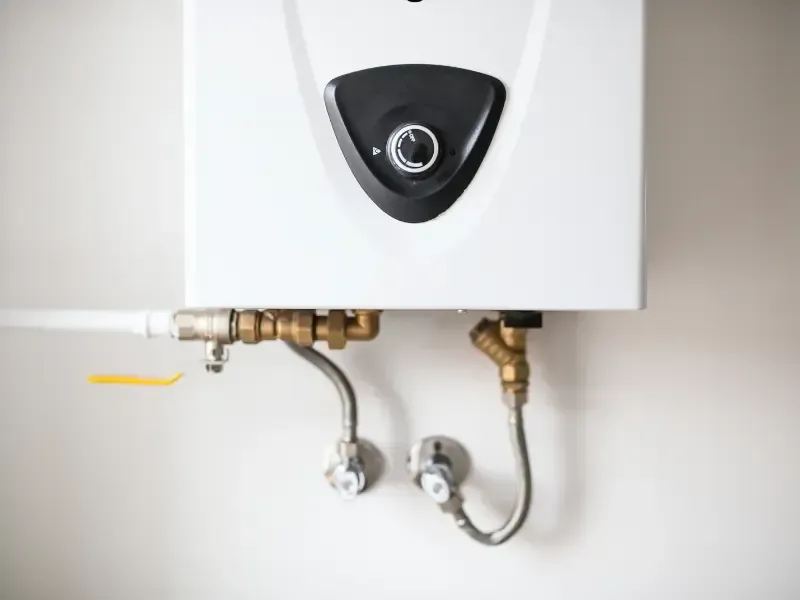
Do You Need a Tankless Water Heater on Mercer Island?
Not everyone does. But if you're on the fence, the deciding factor usually isn't the unit — it's whether your gas line can feed it. A tank heater might draw 40,000 BTU. A whole-house tankless wants three or four times that, and the pipe running to it was never sized for the difference.
By Ramin Shahbaziasl, Owner and Lead Plumber · Last updated August 13, 2026
What Is Specialty Plumbing?
Ask what is specialty plumbing and you'll get a vague answer, because it's a category defined by what falls outside routine work rather than by any single thing.
In practice it covers the jobs that need a specific skill set, a separate certification, or coordination with a utility or the city. Tankless conversions. Gas line work. Sewer line repair and replacement. Backflow prevention assemblies and their annual testing. Water service upsizing. Whole-house filtration and softening.
What those have in common is that they touch something outside your own plumbing — a gas meter, a public sewer, the drinking water supply everyone else shares — which is why they carry extra rules. Our specialized plumbing page covers the range, and routine work sits on the general plumbing page.
Do You Need a Tankless Water Heater?
Honest answer: it depends more on your household than your house.
Tankless makes real sense if you run out of hot water regularly, if your tank sits somewhere you'd rather use for something else, if you're away for long stretches and don't want to keep 50 gallons hot, or if your existing tank is at end of life anyway and you were replacing it regardless.
It makes less sense if your current tank keeps up fine, if you're staying a couple more years, or if the retrofit turns out to need the gas and venting work described below. The efficiency gain is real but it's a slow payback, and anyone selling it as a quick one is being optimistic.
One thing worth knowing: a tankless unit heats water on demand, so it has to produce its full output the moment you open a tap. That's the whole reason the gas requirement is so much higher than a tank's. A tank has all day to reheat itself. A tankless has about two seconds.
The Gas Line Is the Real Cost
Here's what blows up tankless retrofit budgets, and it almost never appears in the advertised price.

Gas is the one to check first. Upsizing a line means running new pipe from the meter, and if the meter itself is undersized the utility has to change it. That's a coordination job with a lead time, not an afternoon. A competent gas line plumber Bellevue area homeowners hire will calculate the load and the pipe run before quoting the heater, because the answer changes the price materially.
Venting is the second. A condensing tankless vents differently from an atmospheric tank, and you can't reuse the old flue. Where the old tank sat in a closet with a B-vent up through the roof, expect new penetrations.
So how much does tankless water heater installation cost is really two numbers: the unit and its install, then whatever the gas, venting, condensate, and electrical work costs on your specific house. Two identical houses can differ by a lot. We look at the meter, the line size, and the run before quoting, and estimates are free.

Why Mercer Island Water Suits Tankless
This one's in your favor, and it's specific to the island.
Scale is what kills tankless heat exchangers. Hard water deposits calcium inside the exchanger, which restricts flow, forces the burner to work harder, and eventually fails the unit. In hard-water areas that means descaling on a schedule and shorter service life.
Mercer Island water comes from Seattle Public Utilities, drawn from the Cedar River watershed — surface water off uninhabited watershed, and very low in dissolved minerals. Soft water means far less scale forming inside the exchanger. Tankless units genuinely last longer here than they do in much of the country, and the descaling interval is longer.
That's the same water chemistry that argues against copper on repiping, where soft, low-alkalinity water is more aggressive toward copper. Same water, opposite conclusion, depending on what you're installing — our Mercer Island repiping guide covers that side. Still fit isolation valves, because "less scale" isn't "no scale."
Backflow Testing Is Annual, and Not Optional
If you have an irrigation system, a boiler, a pool, or certain fire systems, you probably have a backflow prevention assembly. It has to be tested every year.
Washington's cross-connection control rule, WAC 246-290-490, requires that backflow prevention assemblies be inspected and tested at least annually and pass those tests. The plumbing code echoes it at WAC 51-56-0600, which requires that devices protecting the public water system be approved models and tested in accordance with the cross-connection rule. Testing is also required after installation, repair, or relocation.
Two practical points. The test has to be done by a certified Backflow Assembly Tester — a separate certification from a plumbing certificate, so not every plumber holds one. And the results go to your water purveyor, not into a drawer. Miss it and utilities can and do escalate, up to shutting off service.
Anyone asking which plumber handles backflow testing in King County should ask directly whether the person doing the test holds a current BAT certificate. Backflow prevention testing Seattle Eastside homeowners book each year is usually tied to irrigation startup, which is a sensible time to schedule it.
Sewer and Gas: When You Need a Specialist
Two more specialty categories worth a word.
On sewer: when is sewer line repair needed comes down to symptoms rather than age. Multiple slow drains at once, gurgling from a toilet when another fixture drains, sewer smell, an unusually green patch of lawn, or recurring blockages in the same spot. That last one matters most — a line cabled twice in two years has a structural defect, not a habits problem. Trenchless methods often work, though not on a bellied line or a full collapse. Our sewer line repair guide covers the diagnosis, the trenchless options, and where they don't apply. It's written around Redmond's permit process, but the mechanics are the same for sewer line repair King County WA homeowners face anywhere, and the top rated sewer line specialists in the Seattle Eastside all work from a camera inspection rather than a guess.
On gas: do you need a separate gas plumber? Not necessarily a separate company, but gas work does require specific competency and it's worth confirming rather than assuming. Gas is the category where the consequence of getting it wrong isn't a leak in your floor — so ask what qualification the person doing it holds, and expect the work to be pressure tested.
We cover Mercer Island including East Seattle, Mercerwood, and Island Crest, plus Bellevue and the Eastside. Fixture work on the island is on our Mercer Island page, the full service area is on our locations page, completed work is in the gallery, and if something is failing right now, the emergency team is the call.
If you've been searching tankless water heater installation Mercer Island WA or comparing the best tankless water heater installers near Mercer Island WA, ask one question before you compare prices: have you checked my gas line and meter capacity? The answer tells you whether the quote is real.

Frequently Asked Questions
1. What counts as specialty plumbing work?
Work that needs a specific certification, a distinct skill set, or coordination with a utility or the city. Tankless water heater conversions, gas line installation and modification, sewer line repair and replacement, backflow prevention assemblies and their annual testing, water service upsizing, and whole-house filtration. What these share is that they touch something outside your own plumbing — a gas meter, the public sewer, or the shared drinking water supply — which is why they carry extra rules and, in some cases, separate credentials.
2. Do I need a tankless water heater for my Mercer Island home?
It depends on your household more than your house. Tankless suits you if you regularly run out of hot water, want the tank's floor space back, are away for long stretches, or are replacing a failing tank anyway. It suits you less if your current tank keeps up, you're moving soon, or the retrofit needs significant gas and venting work. One point in the island's favor: soft Cedar River water means far less scale inside the heat exchanger, so tankless units tend to last longer here than in hard-water regions.
3. How often does backflow prevention need testing in WA?
Annually. Washington's cross-connection control rule, WAC 246-290-490, requires backflow prevention assemblies to be inspected and tested at least once a year and to pass those tests, with additional testing required after installation, repair, or relocation. The test must be performed by a certified Backflow Assembly Tester, which is a separate certification from a plumbing certificate, so not every plumber holds one. Results go to your water purveyor, and utilities can escalate to shutting off service for non-compliance.
4. What is trenchless sewer repair and is it worth it?
Trenchless covers two methods. Cured-in-place lining pulls a resin liner through the existing pipe and cures it, forming a new pipe inside the old. Pipe bursting fractures the old pipe outward while drawing new pipe in behind, and can upsize the line. Both avoid open-cut excavation, which is what saves driveways and mature landscaping. Neither works on a bellied line holding standing water, since a liner follows the sag, and neither works on a full collapse. A camera inspection decides it.
5. Do I need a separate gas plumber for gas line work?
Not necessarily a separate company, but gas work requires specific competency and it's worth confirming rather than assuming. Ask what qualification the person performing the work holds, and expect the completed work to be pressure tested before it's put into service. This matters particularly on tankless conversions, where the gas load roughly triples or quadruples over a tank heater and the existing line often needs upsizing from the meter — sometimes including a meter change coordinated with the utility.
Visit or Call Us
Eastside Repipe and Plumbing 12005 NE 12th St # 29 Bellevue, WA 98005 Phone: 425-331-2011 Hours: Monday–Sunday, 8:00 AM – 5:00 PM Serving Mercer Island including East Seattle, Mercerwood, and Island Crest, plus Bellevue, Kirkland, and the Eastside.
Thinking about going tankless? Ask for an estimate or call 425-331-2011, and we'll check the meter and the gas line before we quote you a heater.
