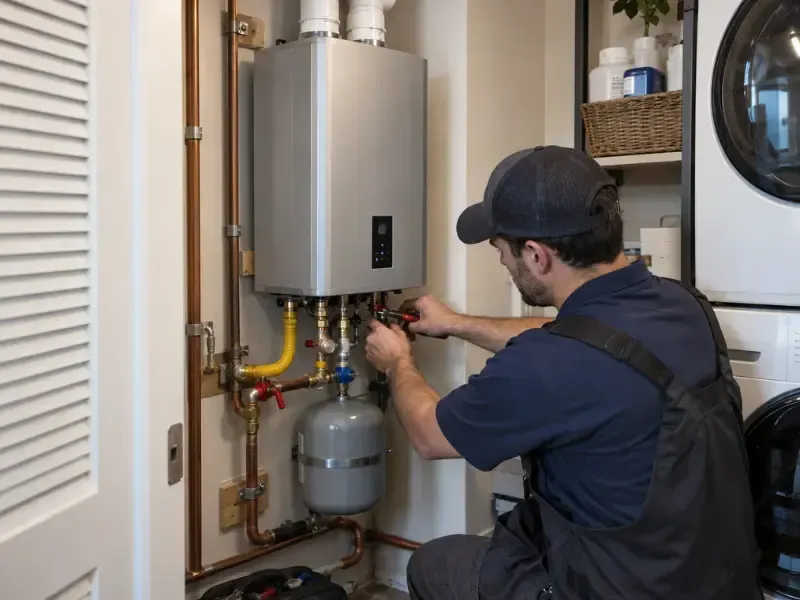
What Does Tankless Water Heater Installation Involve?
More than swapping one box for another, and the number on the box is where most disappointment starts. A tankless unit advertised at 10 gallons per minute will not deliver 10 gallons per minute in Kirkland. Understanding why is the difference between a tankless water heater installation Kirkland homeowners are happy with and one they regret every January.
By Ramin Shahbaziasl, Owner and Lead Plumber · Last updated September 23, 2026
Why Is the Rated Flow Not What You Get?
Because that rating was measured somewhere warmer than here.
A tankless unit has a fixed heat output. It spends that output on two things at once: how much water it moves, and how far it has to raise the temperature. Push one up and the other comes down. So every GPM figure is only meaningful alongside the temperature rise it was measured at.
Here is what that means in Kirkland. Incoming groundwater across the Pacific Northwest commonly sits around 45 to 50 degrees in winter. Set your hot water at 120, and the unit has to achieve a rise of 70 to 75 degrees. In Florida the same unit might only face a 45 degree rise, which is why it delivers far more there.
The arithmetic is unforgiving. Flow is inversely proportional to rise, so a unit rated 5 GPM at a 35 degree rise delivers roughly 2.5 GPM at a 70 degree rise. Half. That is not a defect, it is physics, and it is the single most common reason people feel let down by a tankless conversion.
Two consequences for anyone shopping. Size on winter, not on average, because January is when groundwater is coldest and demand is highest. And ignore the headline GPM unless the rise it was measured at is stated next to it.
How Much Hot Water Will It Actually Deliver?
Can a tankless unit keep up with a larger household? It depends entirely on how many fixtures run at once, and for some homes the honest answer is no.
Work it from your own fixtures rather than your household size. A shower runs roughly 2 to 3 GPM. A dishwasher is similar. A washing machine can take 3 to 5. Add up what genuinely runs simultaneously on your worst morning, then check whether a unit delivers that at a 70 degree rise, not at its headline figure.
A typical residential gas unit tops out around 199,000 BTU per hour, which sets a hard ceiling. Even the largest single gas-fired model can struggle with simultaneous multiple uses in a big household, and that limitation is well documented rather than a sales objection.
Where demand genuinely exceeds one unit, there are two honest answers. Install two units in parallel, which works and costs accordingly. Or stay with a tank, which for some households is simply the better engineering. Our Kirkland replacement guide covers sizing a tank properly using First Hour Rating.
Anyone asking who installs tankless water heaters near me should expect this conversation before a quote, not after the unit is on the wall.
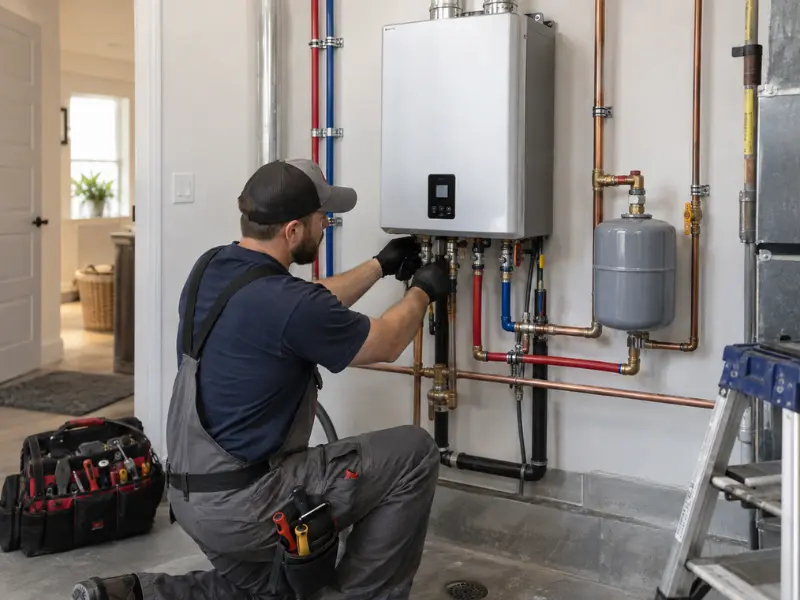
What Is Involved in Converting From a Tank to Tankless?
Five things change, and only one of them is the appliance.
The gas supply. A tank might use 40,000 BTU. A tankless unit can demand 199,000. That usually means upsizing the gas line, and it is the largest hidden cost in most conversions. Our Mercer Island tankless guide covers why, and our gas line guide covers the permitted work involved.
The venting. You cannot reuse a tank's vent. Condensing units vent through plastic, non-condensing units need stainless steel, and either way it is a new run to a new termination.
The electrical supply. Even a gas tankless needs power for its controls and fan, so a dedicated circuit is usually part of the job.
The condensate. Condensing units produce acidic condensate, which needs a drain and usually a neutraliser.
The mounting and water connections. The unit goes on a wall rather than a floor, which frees space but rarely lands where the old tank sat.
That is why a tankless water heater conversion Kirkland homeowners budget as an appliance swap comes in higher than expected. It is closer to a small mechanical project.
When Is a Tankless Worth It?
The genuine advantages. No standby loss, since nothing is kept hot waiting for you. No tank to fail and flood a floor. A long service life, with ENERGY STAR putting tankless life expectancy at around 20 years, well beyond a conventional tank. And wall mounting frees real floor space.
The genuine costs. Higher installed cost, largely from the gas, venting and electrical work above. Annual descaling maintenance that a tank does not require. And the flow ceiling described earlier.
If your gas line is already adequate, your hot water demand is moderate rather than simultaneous, you value the floor space, and you plan to stay long enough to see the running savings. It leans no if two showers run at once every morning, your gas supply needs a major upsize, or you are replacing a failed tank this week under time pressure.
We will tell you which side you fall on. Selling a conversion into a house that needed a tank is how a firm gets one job and no referrals.
What Does Tankless Installation Cost?
Water heater installation cost depends on the unit, the gas supply, the venting route, and what the existing setup lacks.
Four things drive the figure. Whether the gas line needs upsizing, which is the big one. How far the venting has to run to reach a suitable termination. Whether a dedicated electrical circuit exists or has to be added. And whether condensate drainage is available near the mounting position.
Ask any quote to itemise those four rather than presenting one number. A quote that looks notably cheaper than others has usually assumed the existing gas line is adequate, and that assumption is worth testing before you sign.
Financing is available through third-party lenders. Three checks: what the rate becomes after any promotional period, whether the agreement places a lien on your property, and whether the cash price differs from the financed price.
Who Should Do the Work, and Where Do You Serve?
Washington requires two credentials rather than one. The company holds a plumbing contractor licence registered with Labor & Industries, and separately the person doing the work holds their own certificate. Gas work adds its own requirements on top.
Check both free on L&I's Verify a Contractor tool, which also shows the bond, liability insurance and workers' compensation account.
We serve Kirkland plus Bellevue, Redmond, Mercer Island, Sammamish and Issaquah. Tank work sits on our Kirkland installation guide, routine jobs on general plumbing, gas and sewer on specialized plumbing, the area list on our locations page, and finished work in the gallery.
Comparing the best tankless water heater installer near Kirkland, asking who converts homes to tankless water heaters in Kirkland, or wondering which plumber near me handles tankless conversions? Ask what GPM the unit delivers at a 70 degree rise. A gas tankless water heater installer Kirkland homeowners should trust will answer that without checking a brochure.
Frequently Asked Questions
1. How much does tankless water heater installation cost in Kirkland?
Four things drive it, and the unit itself is rarely the largest. Whether the gas line needs upsizing is the big one, since a tank might draw 40,000 BTU where a tankless unit demands up to 199,000. Then how far the venting must run to a suitable termination, since a tank's existing vent cannot be reused. Then whether a dedicated electrical circuit exists, because even gas units need power. And whether condensate drainage is available at the mounting position. Ask for those four as separate line items.
2. Is a tankless water heater worth it for my home?
It leans yes if your gas supply is already adequate, your hot water use is spread rather than simultaneous, you want the floor space back, and you will stay long enough to see the running savings. It leans no if two showers run at once most mornings, your gas line needs a significant upsize, or you are replacing a failed tank under time pressure this week. The advantages are real: no standby loss, no tank to flood a floor, and a service life around 20 years. So are the costs.
3. What is involved in converting from a tank to tankless?
Five changes, and only one is the appliance. The gas supply usually needs upsizing for the much higher BTU demand. The venting is entirely new, since condensing units vent through plastic and non-condensing units need stainless steel. A dedicated electrical circuit is normally required even on a gas unit. Condensing models need a condensate drain and usually a neutraliser for the acidic discharge. And the unit wall-mounts rather than standing on the floor, which rarely suits exactly where the old tank sat.
4. Can a tankless unit keep up with a larger household?
Sometimes, and for some homes honestly not. Size it from fixtures rather than headcount: a shower runs about 2 to 3 GPM, a dishwasher similar, a washing machine 3 to 5. Add what genuinely runs at once, then check the unit delivers that at a 70 degree temperature rise rather than at its headline rating. A typical residential gas unit caps around 199,000 BTU per hour, and even the largest single model can struggle with simultaneous use in a big house. Two units in parallel solve it, or a correctly sized tank does.
5. Do you offer financing for a tankless installation?
Yes, through third-party lenders, and it comes up more on tankless than on tank work because the installed cost is higher. Three questions settle most of it before signing: what the rate becomes once any promotional period ends, whether the agreement places a lien on your property, and whether the cash price differs from the financed price, since a quote that rises when you offer to pay outright has a commission built into it. Ask at the quote stage, because it affects how the work is staged.
Visit or Call Us
Eastside Repipe and Plumbing 12005 NE 12th St # 29 Bellevue, WA 98005 Phone: 425-331-2011 Hours: Monday–Sunday, 8:00 AM – 5:00 PM Serving Kirkland plus Bellevue, Redmond, Mercer Island, Sammamish, Issaquah and the Eastside.
Thinking about going tankless? Request a free estimate or call 425-331-2011, and tell us what runs at the same time on a normal weekday morning.
