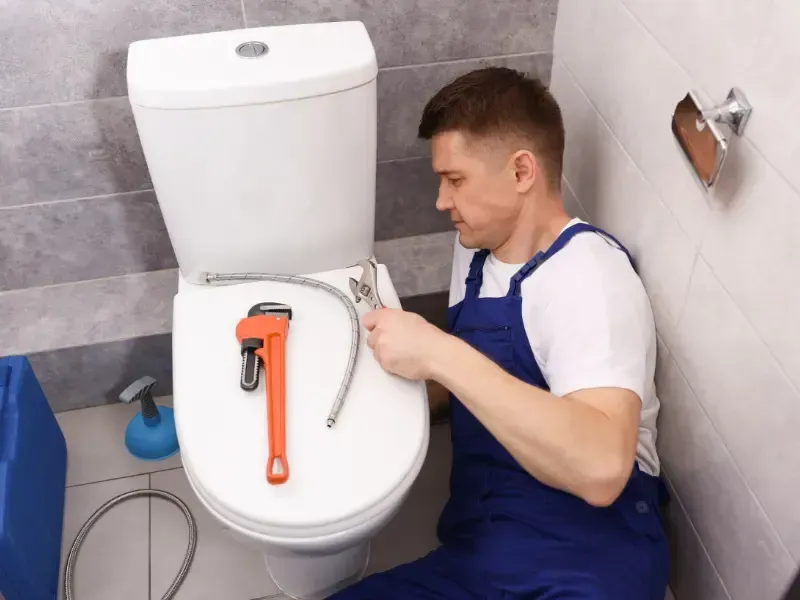
Why Is Your Toilet Running? Small Toilet Repair in Kirkland, WA
Most running toilets come down to one part: a worn flapper that no longer seals against the flush valve, and a five-minute dye test will confirm it before anyone spends money. Eastside Repipe and Plumbing handles small toilet repair in Kirkland, WA, and in a city that bills water bi-monthly, a running toilet can hide for weeks.
By Ramin Shahbaziasl, Owner and Lead Plumber · Last updated August 2026
The Three Failure Zones
Almost every toilet complaint we take maps to one of three zones, and knowing which zone you are in tells you most of what you need. These are the common toilet problems and fixes, sorted by where the water is actually going.
Zone one, inside the tank. The flapper, flush valve seat, fill valve, float, and overflow tube. Symptoms are audible and continuous: running, hissing, or a tank that refills on its own. Water is escaping into the bowl and down the drain, so you never see a puddle.
Zone two, between the bowl and the floor. The wax or rubber seal, the closet flange, and the two bolts holding the bowl down. Symptom is water at the base, often only after a flush, and sometimes only a faint smell before any water appears.
Zone three, the supply side. The angle stop behind the toilet, the braided supply line, and the tank's fill valve shank and gasket. Symptom is water behind or beside the toilet rather than in front of it, and it is usually there all the time rather than only after flushing.

Why Is My Toilet Running?
Ninety percent of the time, the flapper. It is a rubber or silicone disc that lifts when you flush and drops back onto the flush valve seat to hold water in the tank. Rubber hardens, warps, and stops sealing. Water trickles past it into the bowl, the tank level drops, and the fill valve wakes up to top it off — over and over.
Here is how to fix a running toilet diagnostically before you buy anything. Put a few drops of food colouring in the tank, do not flush, and wait fifteen or twenty minutes. If colour appears in the bowl, water is passing the flapper and you need a toilet flapper replacement. If the bowl stays clear but the tank still refills or hisses, the problem is on the fill side rather than the flapper, and you are looking at a fill valve.
Three things worth knowing before you buy a flapper:
Size matters. Flappers come in two-inch and three-inch versions, and they are not interchangeable. Measure the opening or take the old one to the store.
Universal is not always universal. Some flush valve designs need the manufacturer's own part. A generic flapper that almost fits will leak again in a month.
Stop using in-tank drop-in cleaner tablets. They sit in the water dissolving chemicals against every rubber component in the tank. They are one of the most common reasons a flapper we replaced two years ago has failed again. Clean the bowl from the bowl side.
If the bowl stays clear and the tank is quiet but the flush is weak, check the chain. Too much slack and the flapper drops before the tank empties; too little and it never fully seats. A running toilet fix is sometimes just moving the chain one link.

Why Is My Toilet Leaking?
Where the water shows up tells you what failed, and this is the part homeowners most often get backwards. So if you are asking why is my toilet leaking, start by working out whether the water is in front of the toilet, behind it, or underneath the tank.
Water at the base, appearing after a flush. The seal between the bowl and the flange has failed. This is not a tightening job — the seal has to be replaced, which means pulling the bowl. Do not let anyone stack a second wax ring on top of the first.
Water behind the toilet, present all the time. The supply line or the angle stop. Braided lines fail at the crimp, and angle stops weep at the packing nut. Both are small parts, and both are the kind of leak that quietly ruins a subfloor because the toilet hides it.
Water under the tank, worst right after flushing. The tank-to-bowl bolts or the spud gasket between them. A rubber gasket kit fixes it, but the tank has to come off the bowl to do it properly.
Condensation, not a leak at all. In a humid bathroom with cold supply water, a tank can sweat enough to pool on the floor and convince you there is a leak. Wipe the tank dry and watch whether the water returns from below or forms on the porcelain.
Leaking toilet repair in zones two and three is where we would push back on the DIY instinct — not because the parts are complicated, but because the failure mode is a slow leak into the floor that costs far more than the repair.
Why a Running Toilet Costs More in Kirkland Than You Think
This is the part that is specific to Kirkland, and it is a money argument rather than a plumbing one.
The City of Kirkland bills water, sewer, and garbage on a bi-monthly basis. That means a toilet that starts running the week after a bill is issued can run continuously for close to two months before anything on paper tells you. A continuously running toilet is the largest single leak most households will ever have — far more water than a dripping tap — because it runs at supply pressure, day and night, straight down the drain. The City publishes its own guidance on troubleshooting a high water bill, and a toilet is the first thing worth ruling out.
There is a second, more useful piece. Kirkland offers leak adjustments to qualifying utility customers, administered through Finance and Administration alongside utility billing. The City's leak adjustment form asks applicants to attach copies of all receipts, repair bills, and photographs relating to the leak.
Two practical implications. First, keep the paperwork — a documented invoice and a photo of the failed part are what an adjustment request needs, and a cash repair with no paper trail gives you nothing to submit. Second, check eligibility for your specific situation before assuming, because leak adjustment programmes across the region treat visible fixture leaks differently from concealed underground leaks, and the terms vary. Ask the City directly. We provide an itemised invoice with photographs on every repair as a matter of course, which costs you nothing and occasionally recovers real money.
Because the meter only reports every two months, the cheap habit is to run the dye test on every toilet in the house twice a year. It takes twenty minutes and it is the single highest-return thing a homeowner can do about water bills.
What Small Toilet Repair Costs and How Long It Takes
Taking the money question first, how much does small toilet repair cost is mostly a labour question, because the parts are inexpensive. A flapper is a few dollars. A fill valve, a tank-to-bowl gasket kit, or a braided supply line typically runs ten to twenty-five dollars at retail. Nobody is making money on the components.
What that means practically is that the trip is the cost, so the economics reward bundling. If one toilet is running, test the others; if the angle stop is weeping too, do both while the water is off. Two fixtures on one visit is meaningfully cheaper than two visits, and this is the single best piece of advice we can give about small plumbing repairs. We quote on site and estimates are free.
On timing, a flapper or fill valve replacement is usually inside thirty minutes. A tank-to-bowl gasket takes longer because the tank has to come off. A bowl-to-floor seal means pulling and resetting the toilet, so budget an hour or more, and longer if the flange or the angle stop turns out to need work once things are apart. Where a shutoff will not hold and the water has to come off at the main, that is a different conversation — and if a supply line has burst or a bowl is overflowing, call our emergency plumbing team rather than reading further.
Should You Repair or Replace?
Repair is usually right, and the honest small toilet repair vs replacement guide for a toilet is different from the one for a tap, because the deciding factor is water consumption rather than the condition of the fixture body.
Repair when the toilet is post-1994, the porcelain is sound with no hairline cracks, and this is a first or second parts failure. A modern toilet with a fresh flapper and fill valve is essentially a new toilet where it counts. Rebuilding the tank internals of a good fixture is excellent value.
Consider replacing when the toilet predates 1994. Fixtures from that era can use up to six gallons per flush, and Washington's current requirement for new installations is 1.28 gallons — so replacement cuts that toilet's water use by roughly three quarters, permanently, and pays for itself on a bi-monthly bill in a way that no repair can. Repairing a six-gallon toilet restores it to wasting six gallons a flush very reliably. Also replace where the porcelain is cracked, where the flush valve design is obsolete and parts are no longer available, or where you have rebuilt the same fixture more than twice.
If you land on replacement, our guide to toilet installation in Kirkland covers rough-in measurement, fixture selection, and what the code requires. If the running toilet turns out to be one symptom among several across the house, our faucet repair guide covers the supply-pressure side of that pattern, and broader work sits on our general plumbing page.

Kirkland Areas We Serve
Toilet repairs are the same job across the city, with one variable: how old the shutoff behind the toilet is. In newer housing the angle stop closes cleanly and a thirty-minute repair stays a thirty-minute repair. In the older stock around South Rose Hill, Willowdale, and South Juanita, a quarter of the valves we meet will not fully close, which turns a small part swap into a valve replacement — worth knowing when you compare quotes, because an honest estimate mentions it as a possibility rather than discovering it as a surprise.
We cover Kirkland and the wider Eastside. Our Kirkland plumbing page lists residential services, our Kirkland service area page covers everything we handle locally, and toilet work specifically is on our Bellevue, Bothell, and Issaquah pages. The full city list is on our locations page and recent work is in our project gallery.
If you have been searching small toilet repair Kirkland and comparing the best toilet repair plumbers in kirkland, two questions sort the field. Will they run a dye test and tell you it is a five-dollar flapper rather than selling you a fixture? And will they leave you an itemised invoice with photographs, so you have something to submit if you go after a leak adjustment?
Frequently Asked Questions
1. How much does small toilet repair cost in Kirkland?
The parts are cheap and the labour is the cost. A flapper is a few dollars; a fill valve, gasket kit, or braided supply line generally runs ten to twenty-five dollars at retail. What you are paying for is the visit and the diagnosis, which is why bundling matters — testing every toilet in the house and fixing several fixtures on one trip costs far less than separate call-outs. Repairs that require pulling the bowl or replacing a seized shutoff valve cost more than tank-internal work. We quote on site at no charge.
2. Why is my toilet running constantly?
Almost always a worn flapper failing to seal against the flush valve, so water trickles into the bowl and the fill valve keeps topping the tank up. Confirm it with a dye test: add food colouring to the tank, do not flush, and wait fifteen to twenty minutes. Colour in the bowl means the flapper is leaking. If the bowl stays clear but the tank still refills or hisses, the fill valve is the culprit instead. A slack or overtight chain can also hold the flapper off its seat.
3. Can I fix a leaking toilet myself?
It depends which zone is leaking. Tank internals — flapper, fill valve, chain — are genuinely DIY-friendly with a working shutoff valve and the correct part size. Leaks at the base of the bowl are not, because the fixture has to be pulled and the seal replaced, and a badly reset toilet leaks slowly into the subfloor for months before it shows. Supply-line and angle-stop leaks sit in between: simple in principle, but if the shutoff will not close you are shutting off the whole house.
4. How long does a small toilet repair take?
A flapper or fill valve replacement is usually done inside thirty minutes. A tank-to-bowl gasket takes longer because the tank has to come off the bowl. Replacing the bowl-to-floor seal means pulling and resetting the toilet, so budget an hour or more. Add time if the flange needs an extender or the angle stop will not hold and has to be replaced — both are common in older homes and both are discovered once the work is underway.
5. Should I repair or replace my toilet?
Repair if the toilet is from 1994 or later, the porcelain is sound, and this is a first or second parts failure — new tank internals in a good fixture are excellent value. Replace if the toilet predates 1994, because those fixtures can use up to six gallons per flush against the 1.28 gallons required for new installations today, and the water savings outweigh any repair. Also replace where porcelain is cracked, parts are discontinued, or you have already rebuilt the same fixture twice.
Visit or Call Us
Eastside Repipe and Plumbing 12005 NE 12th St # 29 Bellevue, WA 98005 Phone: 425-331-2011 Hours: Monday–Sunday, 8:00 AM – 5:00 PM Serving Kirkland and surrounding areas including South Rose Hill, Willowdale, and South Juanita, plus Redmond, Bellevue, Bothell, and Issaquah.
Toilet running and not sure why? Request a free estimate or call 425-331-2011, and we will run the dye test, fix what actually failed, and leave you an itemised invoice with photographs.
