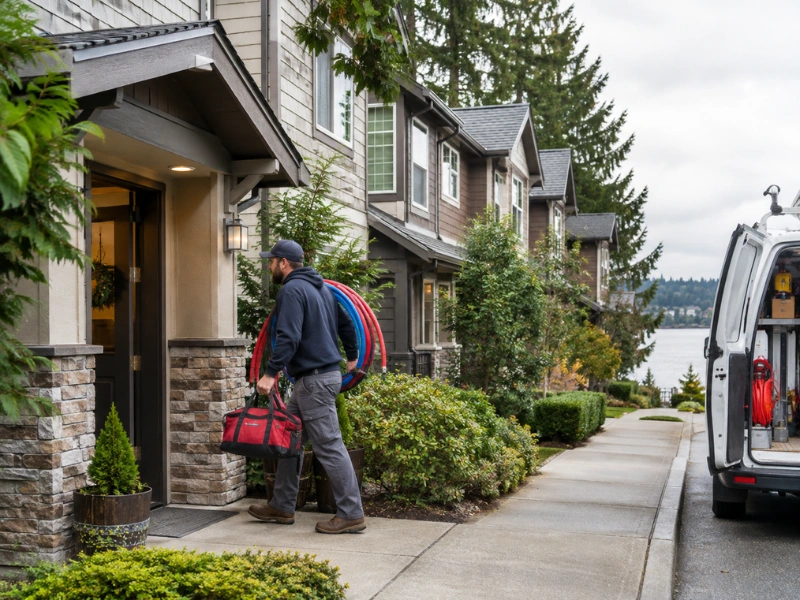
How Does Repiping Work In A Kirkland Condo Or Townhome?
Repiping a Kirkland condo or townhome works much like a house repipe, except the job stops where your home meets the building. We swap the old supply lines inside your walls for new PEX or copper, route them away from shared walls, and then tie them back into the building's water at your unit's connection point, with HOA approval and a City of Kirkland permit in place first.
By Ramin Shahbaziasl, Owner · Last updated November 23, 2026
Why is repiping a townhome or condo different from a house?
Repiping a townhome or condo is different because you're working inside a shared structure, so the routing, the paperwork and the schedule all have to fit around other homes. In a detached house, we pick the easiest path from the main line to each fixture. In an attached home, that path is boxed in on several sides.
Here's what changes once there's a neighbor on the other side of the drywall:
Party walls are fire-rated. Townhome separation walls are built to slow a fire, so we run new lines along interior walls and leave the shared wall alone wherever we can.
Layouts are stacked. Kitchens and bathrooms are often built back to back with the home next door, which keeps runs short but leaves less room to work.
Floors may be concrete. Mid-rise condo buildings often have concrete slabs between levels, so new lines go overhead through ceilings and soffits instead of underfoot.
The HOA sets the calendar. Work hours, parking, elevator use and noise rules come from the association, not from us.
The good news? A condo flat usually has fewer fixtures and shorter runs than a two-storey house. So once the planning is done, the actual pipe work tends to move quickly.
What do shared risers and stacks mean for your new pipes?
Shared risers and stacks are the vertical pipes that carry water up through the building and waste down, and your new lines have to connect to them cleanly. A riser feeds every home lined up along it. A stack does the same job in reverse for drains and vents. When we repipe one home, we replace the branch lines that come off the riser, not the riser itself.
That matters for three reasons:
The riser may be as old as your pipes. If we open a wall and find a corroded galvanized riser, we photograph it and tell you before connecting anything. Brand-new PEX tied to a failing riser still leaves you exposed.
Mixed metals need the right fitting. Joining copper straight to galvanized steel invites corrosion at the joint, so we fit a dielectric transition where new meets old.
You should get your own shutoff. We add a new full-port ball valve where your lines start, so a future faucet or toilet swap doesn't mean calling the building manager.
The City of Kirkland takes this layout seriously, too. Its plumbing permit checklist can call for plans with a riser diagram showing waste, vent and water pipe sizes, but it says plans aren't required for one- and two-unit residential buildings. In other words, a duplex townhome and a 40-unit condo building can face different paperwork for very similar work.
Is water already coming through a shared wall? Then deal with that first. Our guide to stopping leaks between units walks through the right order of shutoffs, and the repipe conversation can wait a day.
How does the work move through a condo flat versus a townhouse?
The work follows the shape of the home. A condo flat gets repiped across one level from a single connection point, while a townhouse is repiped floor by floor from a manifold. Owners searching how is a townhouse repiped often picture walls torn open from top to bottom, but it's far less dramatic than that.
In a typical two- or three-storey townhouse, we:
set a manifold near the water heater, usually in the garage or a ground-floor closet
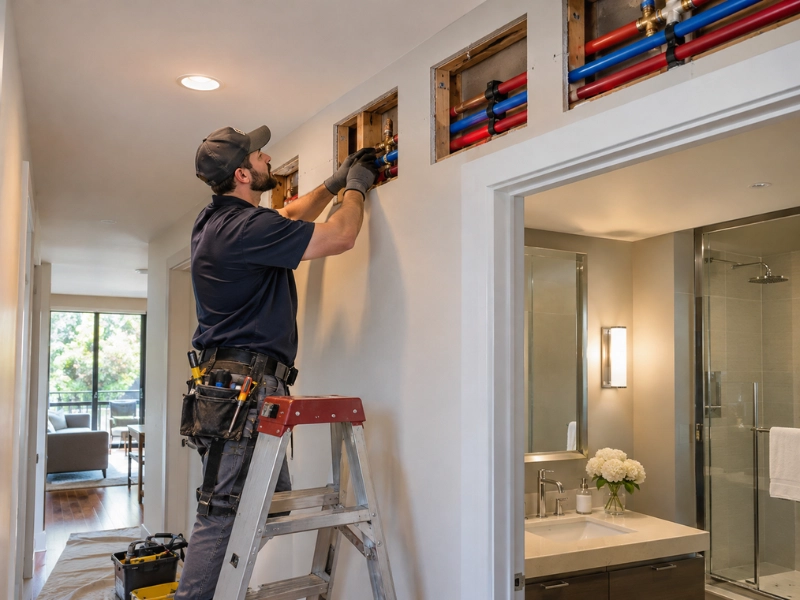
run separate PEX lines up through interior walls and the space between floors
cut small, square openings at each fixture rather than long slots in the drywall
pressure-test the whole system before any wall is closed
A condo flat is simpler on paper. The new lines leave one connection point and travel through the ceiling, soffits or interior walls to the kitchen, bathrooms and laundry. The tricky part is headroom. Many older Eastside condos have low ceilings with little space above them, so we sometimes box new lines into a slim soffit that's painted to match.
Either way, the Kirkland inspector sees the new pipe under test pressure before drywall goes back. After that, we patch the openings so the rooms are ready for paint. For the materials and methods we use on every job, see our repiping service page.
Which pipe materials turn up in Kirkland attached homes?
The pipe behind your walls depends mostly on when the building went up, and Kirkland's attached housing spans almost every era. Many of the condo and townhome complexes we see in neighborhoods like Juanita and Totem Lake date from the 1970s through the 1990s. That overlaps with the years polybutylene was widely used.
When it was built | Supply pipe you'll often find | What we check first |
|---|---|---|
Before the mid-1970s | Galvanized steel, often with copper patches | Rust at threaded joints, weak pressure upstairs, brown water after a trip |
Late 1970s to mid-1990s | Gray polybutylene or early copper | Cracked fittings and brittle or flaking pipe |
Mid-1990s to mid-2000s | Copper, some CPVC | Pinhole leaks in copper, brittle CPVC near the water heater |
Late 2000s onward | PEX | Usually sound, so repairs tend to be spot fixes |
If your building fits that middle row, get the lines looked at even without a leak. Polybutylene tends to fail at the fittings with very little warning, and in a stacked building, one failure can reach the homes below you before you notice it.
Other signs point the same way, whatever the era:
Rust-colored or cloudy water when a tap first opens
Pressure that drops when a second fixture runs
Repeat leaks in different spots within a year or two
What should you line up before the crew arrives?
You'll want three things settled before day one: the association's sign-off, a permit and a clear work area. Sorting them early is what keeps a repipe on schedule.
Association approval. Most HOAs want a written scope, proof of insurance and dates before plumbing work starts. Your property manager will tell you what their form looks like.
A City of Kirkland permit. The city requires a plumbing permit for work on plumbing systems, and applications go through MyBuildingPermit. Kirkland's plumbing permit process page lays out the steps, and we handle the application and inspection booking for you.
Empty cabinets and closets. Clear the cabinets under every sink, plus any closet that shares a wall with a bathroom or kitchen.
Pets and parking. The crew will be in and out of your front door all day, and many complexes limit contractor parking, so ask the manager where our truck should go.
It also helps to tell us about any finishes you care about, such as tile backsplashes or custom built-ins. Then we can plan openings around them instead of through them.
Planning a repipe in your Kirkland condo or townhome?
Call: 425-331-2011
Offer: Free on-site estimate
Serving: Kirkland, Bothell and the rest of the Eastside
Where do we take on repiping in Kirkland and Bothell?
We take on repiping in Kirkland WA across the whole city and north into Bothell, working from our Bellevue shop a short drive down I-405. In Kirkland, that includes Juanita, Totem Lake, Kingsgate, Finn Hill, Rose Hill and Houghton, along with the condo buildings near downtown and the waterfront. You'll find more about local service on our Kirkland plumbing page.
North of the city, we work in Canyon Park, North Creek and downtown Bothell, which our Bothell page covers in more detail. We're also close by for owners in Bellevue and Redmond.
If you've been searching for repipe contractors near Kirkland and Bothell WA, pick one that has handled repiping a townhome or condominium unit on the Eastside before. HOA paperwork, fire-rated walls and stacked layouts trip up crews who mostly work on detached houses, and that's where most delays come from.
Frequently asked questions
1. Can one unit be repiped without the rest of the building?
Yes, a single condo unit can be repiped on its own without touching any other home in the building. Boards sometimes push for a building-wide project when several units are failing from the same era of pipe, so it's worth checking whether one is already planned before you sign.
2. Which pipes are yours and which are the building's?
In most Washington communities, piping inside your walls that serves only your home is yours or assigned to you, while risers, mains and anything serving more than one home are common elements. Your community's declaration draws the exact line, so that document settles what is shared and what is yours in an attached home.
3. How is access handled when the work crosses a shared wall?
Access between units is arranged through your HOA or property manager, who gives the neighbor notice and agrees on a time window before anyone opens the shared wall. Any opening in a fire-rated wall is sealed with a listed firestop system and patched before the final inspection, so the separation between homes is restored.
4. How long is water off for the neighbours, not just for you?
Neighbors usually lose water only during the tie-in at the riser, which typically takes a few hours or less and is booked ahead with the building. Your own water is off far longer, generally during working hours across the job, and we sequence the work so you aren't left without water overnight wherever the layout allows.
5. What does a single unit cost against a whole building?
A single unit usually costs more per home than the same unit would as part of a whole-building repipe, because setup, permitting and the riser tie-in aren't spread across many units. The total is still far smaller than a building-wide project, and we price each job after a free on-site estimate since fixture count, routing and drywall work drive the number.
Visit or Call Us
Eastside Repipe and Plumbing
Address: 12005 NE 12th St # 29, Bellevue, WA 98005
Phone: 425-331-2011
Family-owned repiping and plumbing company led by Ramin Shahbaziasl
Serving Kirkland, Bothell, Bellevue, Redmond and the wider Eastside. Call for a free estimate, or use our contact page to book a visit.
