What Emergency Plumbing Steps Stop Leaks Between Units?
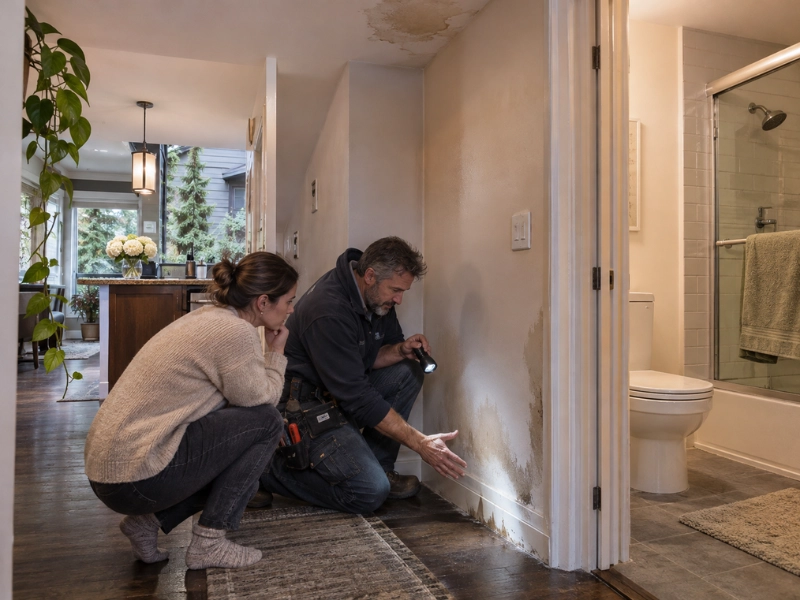
The emergency plumbing steps that stop a leak between units come down to three moves. Shut the closest valve that controls the leak, kill the power near the wet wall, and get a plumber looking for the source before anyone starts cutting drywall. In a townhome, you don't get much time to think about it, because water inside a shared wall rarely stays on your side for long.
By Ramin Shahbaziasl, Owner and Lead Plumber · Last updated November 20, 2026
What makes emergency plumbing different in an attached home?
It's different because the problem stops being just yours. Your pipes, your neighbour's pipes and the lines you share all run through the same walls and floors.
So when someone in a townhome calls for emergency plumbing in Kirkland, WA, a few things work against them:
Water travels sideways and downward, not only into the room where the leak began.
The stain you're staring at might be coming from next door, or from the unit above.
The valve that would stop it could be in a closet or garage that isn't yours.
Picture a slow drip behind a bathroom vanity. In a detached house, you'd probably lose a section of ceiling. In a row of townhomes, though, that same drip can reach two kitchens before anyone smells damp drywall.
Why is water reaching a neighbouring unit so fast?
Water gets next door quickly because it takes the easiest route, and in attached homes that route usually follows the shared framing rather than soaking into your floor.
These are the paths we see it take most:
Along the bottom of the party wall, right where drywall meets subfloor
Down the stack chase, the boxed-in space that carries drains from floor to floor
Across the joists, in the gap above the ceiling of the unit below
Out through the neighbour's can lights, bath fan or outlet boxes
Many party walls are actually two separate stud walls with an air gap in between. That gap is great for sound and fire separation. It's terrible for spotting leaks, because water can run to the bottom and spread out before a single mark shows up on either side.
Here's a quick test that helps. A supply leak won't stop on its own, but a drain leak only runs when something drains. Supply lines sit under constant pressure, so they keep pushing water until a valve closes. A cracked drain, by contrast, might only drip while someone upstairs is showering. So if the wall is still wet at 6 a.m., you're almost certainly looking at a supply line.
What runs through shared walls and stacks?
Shared walls and stacks usually hold the main drain stack plus each unit's branch drains. In some complexes, they also carry supply lines that feed more than one home, which is why it pays to know what's behind the drywall.
Pipe | What it serves | Who usually maintains it | How a leak tends to show up |
|---|---|---|---|
Main drain stack | Several units, stacked or side by side | The association, as a common element | Stains on lower floors after upstairs fixtures drain |
Unit branch drain | One unit's toilet, tub or sink | That unit's owner | A wet ceiling under one bathroom, only during use |
Unit supply line | One unit's fixtures | That unit's owner | A damp wall that stays wet even overnight |
Shared supply or main | Several units from one meter | The association or the shared owners | Low pressure in more than one home |
Vent stack | Drain venting through the roof | The association | Water after heavy rain, often at the roof flashing |
That "who maintains it" column comes from Washington's common interest ownership law (RCW 64.90.440). Under it, the association looks after common elements and each owner looks after their own unit. Still, your declaration can carve things up differently, and some Kirkland complexes hand sections of the stack to individual owners.
Age plays a part too. Homes built between the late 1970s and the mid-1990s may still have gray polybutylene supply lines, and those tend to let go at the fittings. Older buildings sometimes have galvanized steel that rusts from the inside out. If the same lines keep failing, a whole-home repipe usually costs less than paying for one emergency after another.
What's the right order for stopping the water in an attached home?
Start at the valve closest to the leak and only move outward if it doesn't work. Jumping straight to the building main can leave neighbours without water when they didn't need to lose it.
The fixture stop. It's the small valve under the sink, behind the toilet or at the washer. Turn it clockwise until it stops.
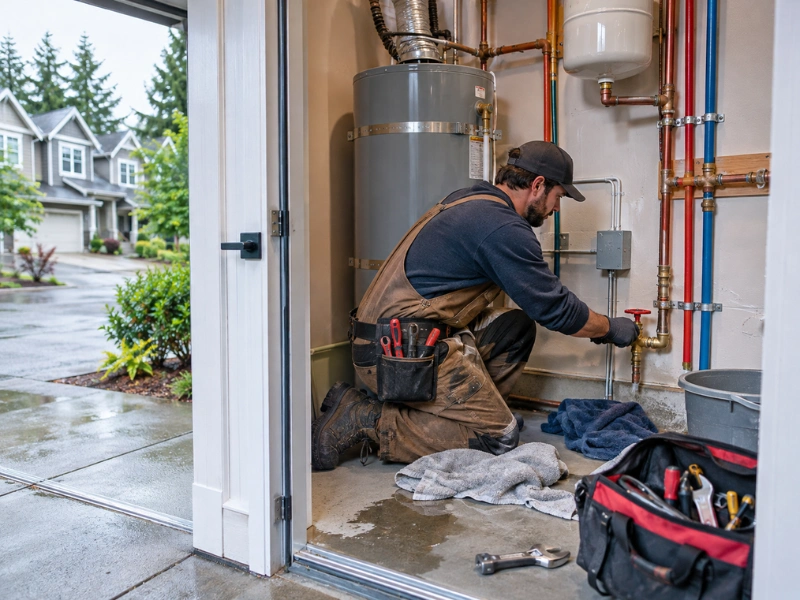
The water heater's cold inlet. If the heater's the problem, close the valve on the cold line going into it.
Your unit's main valve. This one shuts off every fixture in your home at once.
The meter. For homes on Kirkland city water, the city's home water guide says the meter usually sits in a black plastic box along the property frontage. It also shows how to close the meter valve with a crescent wrench. And if the trouble is on the city's side of the meter, Kirkland Public Works has a 24/7 emergency line at 425-587-3900.
Then think about electricity. If there's water anywhere near outlets or light fixtures, flip the breaker for that area before you touch anything wet. After that, it's towels, buckets and moving anything you care about away from the wall.
Water still moving after you've closed a valve?
Call: 425-331-2011
Email: [email protected]
Free estimates on every repair
Which mistakes make a cross-unit leak worse?
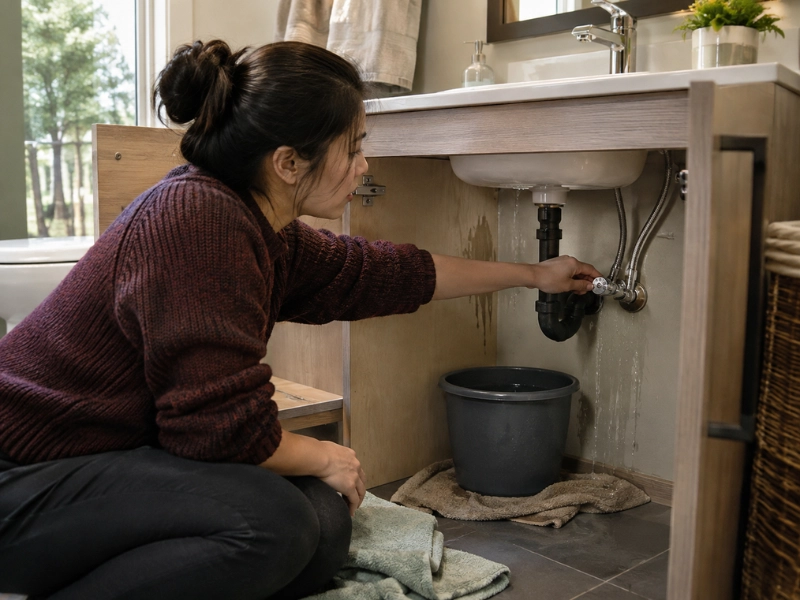
Waiting, running fixtures to "find" the leak and opening walls too soon cause the most extra damage. Every one of them puts more water into a cavity nobody can see into.
A few habits we'd talk you out of:
Testing fixtures one at a time. Flushing or running taps to find the culprit just feeds the wall more water.
Muscling a stuck valve. Old multi-turn valves can snap at the stem. If it won't move with firm hand pressure, go to the next valve instead.
Cutting drywall with the power still on. Wiring often shares the cavity with the pipes.
Mopping up and calling it done. Water trapped under flooring can start growing mold within a day or two, even when the surface looks fine.
Deciding whose fault it is too early. Until someone finds the failed pipe, it's nobody's leak and everybody's problem.
Stop the flow, protect what you can, then let a plumber with proper tools do the hunting.
Where in Kirkland do these leaks show up most?
They show up wherever homes share walls. In Kirkland, that's the newer townhome rows around Totem Lake, and it's just as often the older condo and townhome complexes in Juanita and Houghton.
If you're searching for emergency plumbers near Kirkland and Totem Lake WA, it helps to know which kind of building you live in:
Newer construction usually has PEX lines run from a manifold, tight mechanical closets and stacked floor plans. Leaks there tend to start at fittings, appliance hookups and water heater connections.
Older complexes are more likely to have polybutylene, galvanized steel or tired copper, plus shutoff valves nobody has turned in years.
Cold snaps bring their own risk. Pipes in exterior walls or above unheated garages freeze first, and end units often have both. When a frozen line splits, it's a supply leak, so it'll keep going until someone closes a valve.
Our Kirkland plumbing page covers day-to-day service around the city. We also work in nearby Bellevue, Redmond and Bothell, where attached homes run into exactly the same trouble.
What does a plumber do once they arrive?
The first job is making sure the water has actually stopped. After that, it's about finding which pipe failed and which side of the wall it's on.
On a typical visit, that looks like this:
Check that the shutoff is holding, and move to a better valve if it isn't.
Trace the source with moisture readings and leak detection, plus a pressure test on the supply lines.
Open the smallest access hole possible, ideally on the side where the leak started.
Fix the failed section, or make a temporary repair if the full job needs planning.
Turn the water back on, recheck both units and write down where the leak began and what was replaced.
Good emergency plumbing in an attached home is mostly about doing things in the right order. Close the right valve, keep power away from water and let someone find the source before the saws come out. Do that, and a leak through a shared wall stays a repair instead of turning into a renovation.
Frequently asked questions
1. Water is going through the wall into the next unit - what now?
What you do if water is going into a neighbour's unit is shut off your supply at the closest valve, then knock, call or text your neighbour so they can move their things and switch off power near the wet wall. With a leak spreading between units in a Kirkland townhome, call us at 425-331-2011 next so the source gets found before the water travels any further.
2. Where is the shutoff when it is not in your own home?
Where the shutoff is in a townhouse depends on how the complex was plumbed, and when it isn't inside your home it's usually in a shared mechanical closet, a neighbour's garage or a meter box near the street. Your HOA or property manager knows the location and holds the key, so ask for both now and write them down somewhere you'll find them in a hurry.
3. Who needs telling, and how fast?
Your neighbour needs to hear first, within minutes, then your HOA or property manager, then your insurance company the same day. If you rent, call your landlord straight away too, and send each report by text or email so everyone has a timestamped record.
4. How do you get access to a neighbouring unit at two in the morning?
Call the HOA or property manager's after-hours line, since most associations keep an emergency contact or key holder for exactly this kind of night. If nobody can open the door, the flow can usually still be stopped from your side or at the shared shutoff, and the repair inside waits until the owner or manager lets a plumber in.
5. What happens to the damage on the other side of the wall?
The damage on the other side gets dried out, documented and repaired, and who is responsible when a leak crosses units depends on where the leak started and what your community's declaration says. In most cases each owner claims on their own policy first and the insurers sort out the rest, so hang on to photos, the plumber's written findings and the failed part.
Visit or Call Us
Eastside Repipe and Plumbing
Address: 12005 NE 12th St # 29, Bellevue, WA 98005
Phone: 425-331-2011
Email: [email protected]
Family-owned repiping and plumbing company based in Bellevue
Serving Kirkland, Totem Lake, Juanita, Houghton, Bellevue, Redmond and Bothell. Call for a free estimate, or use our contact page to book a visit.
