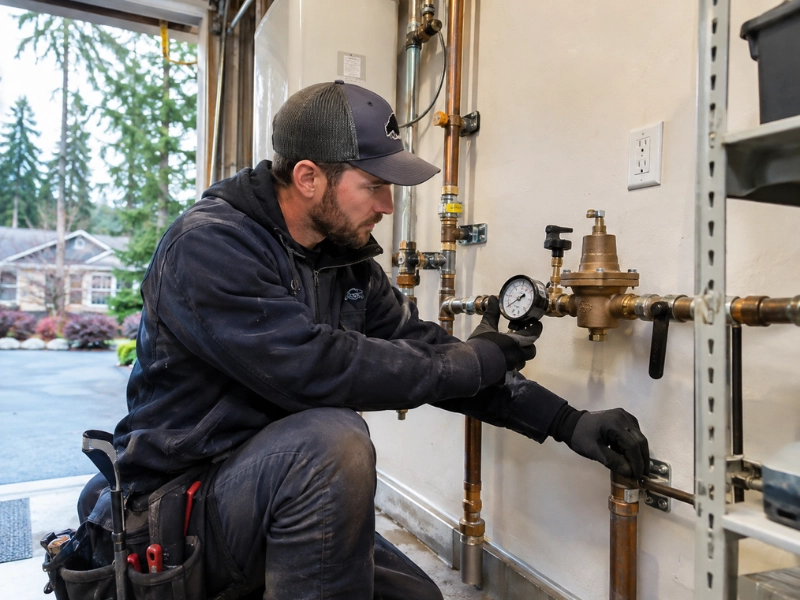
When Should You Call A Plumber About Water Pressure?
You should call a plumber when a gauge at your hose bib reads above 80 psi or below about 40 psi. The same goes for pressure that changes at every fixture at once, or swings between strong and weak during the day. At Eastside Repipe And Plumbing, we test and fix pressure problems in homes across Redmond, Kirkland and the rest of the Eastside, and every visit starts with a real reading instead of a guess.
By Ramin Shahbaziasl, Owner · Last updated November 25, 2026
How do you tell if water pressure is too high or too low?
You tell by measuring it, because the way a shower feels is a poor guide. If you suspect you'll find your water pressure too high or too low, a $10 to $20 gauge from any hardware store settles it in about a minute.
Here's the quick test we suggest:
Turn off every tap, plus the dishwasher, washer and sprinklers.
Thread the gauge onto the hose bib nearest the main shutoff.
Open the bib fully and read the needle. That's your static pressure.
Leave it on overnight if it has a red "max" needle, since that catches hidden spikes.
On some Eastside homes, though, the front hose bib is teed off before the house's pressure valve. So if the number looks odd, test at the water heater's drain valve instead.
Then compare your reading with this table:
Gauge reading | What it usually means | What to do next |
|---|---|---|
Below 40 psi | A restriction, a leak or weak supply | Check the main shutoff, then book a flow test |
40 to 60 psi | The normal, comfortable range | Nothing, but recheck once a year |
60 to 80 psi | Allowed, but hard on fixtures | Lower it if toilets run or faucets drip |
Above 80 psi | Too high under plumbing code | Needs working pressure control, so call us |
Higher overnight than by day | Thermal expansion from the water heater | Have the expansion tank checked |
Those numbers line up with federal guidance. The Building America service water pressure guide from Pacific Northwest National Laboratory recommends keeping homes at 60 psi or less. It also notes that most plumbing codes require pressure control once supply tops 80 psi.
Why does elevation change pressure across the Eastside?
Elevation changes pressure because water gains about 0.43 psi for every foot your home sits below the reservoir feeding it. So a house 100 feet downhill from its tank gets roughly 43 psi more than one at tank level. The Eastside is all ridges and valleys, so two homes a few blocks apart can read 50 psi and 120 psi.
In fact, that's usually the honest answer to what causes high water pressure in a house around here. It's often not a fault at all, but simply where the home sits in its utility's pressure zone. Education Hill and Grass Lawn rise well above downtown Redmond and the Sammamish River valley. Kirkland, meanwhile, climbs from the lake up through Rose Hill and Finn Hill.
Kirkland's Highlands neighborhood shows how this plays out. According to the City of Kirkland's Highlands pressure updates, many homes there ran over 80 psi before a 2024 system change. The city then asked upper Highlands owners to reinstall or inspect their pressure valves before raising pressure again in 2026.
Most of the water pressure problems in Redmond WA that reach us follow one of two patterns. Either a valley home has strong supply and a tired valve, or a hilltop home loses flow when two showers run at once.
Is your gauge reading high, low or all over the place?
Call: 425-331-2011
Email: [email protected]
Offer: Free estimate on any water pressure repair
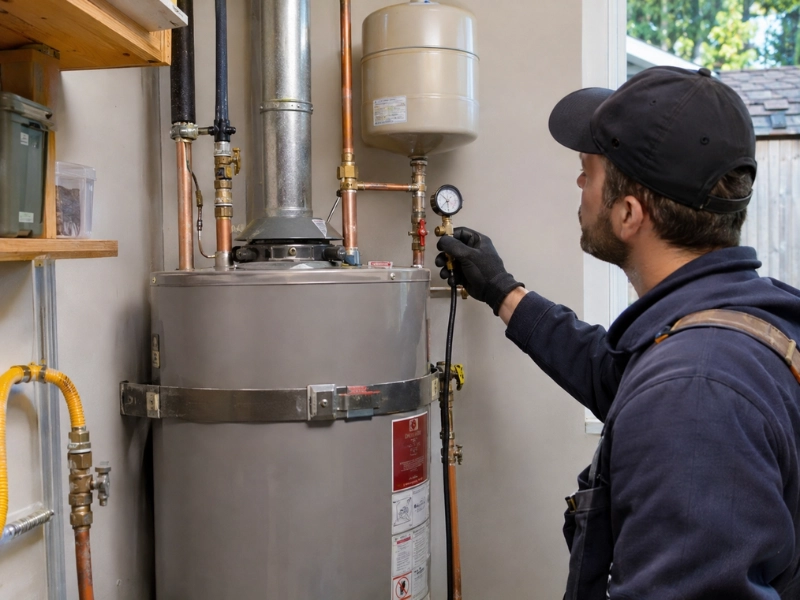
Why does pressure spike when the water heater runs?
Pressure spikes because water grows in volume as it heats, and in most homes that extra water has nowhere to go. A 50-gallon tank adds roughly half a gallon each time it heats up. Because the meter or pressure valve blocks it from flowing back to the street, the system squeezes tighter.
As a result, pressure can climb far above your normal reading every heating cycle. You'll notice it as:
a relief valve on the water heater that drips or weeps
toilets that refill on their own after someone showers
a gauge whose max needle sits well above the static number
The fix is a thermal expansion tank on the cold line, with its air charge set to match house pressure. However, those tanks lose their charge over time, so an old tank can hang on the wall doing nothing. That's why we test the tank during every water heater replacement in Redmond and on every pressure call.
What makes pressure problems worse over time?
Old pipe, hidden leaks and growing demand make pressure problems worse, and none of them fix themselves. High or low water pressure in an Eastside home rarely holds steady for long, because the cause keeps building. These are the slow ones we find most often:
Galvanized supply pipe. Steel pipe in older ramblers and split-levels rusts from the inside. Then scale narrows the line until flow is a trickle. Our galvanized pipe replacement guide for Redmond explains how to spot it.
An undersized service line. Many older homes still run a 3/4-inch line that was sized for one bathroom. Add a second bath, irrigation and a big washer, and the line simply can't keep up.
Hidden leaks. A leak inside a wall or under a slab steals flow quietly while the bill creeps up. Leak detection in Redmond finds these without tearing out drywall.
Sediment after street work. When the city flushes or repairs a main, grit often lands in fixture screens and valve strainers.
Before you call, try the meter test. Turn off every fixture, then watch the small leak dial on your water meter for ten minutes. If it moves, water is going somewhere it shouldn't.
What does a plumber check on a water pressure visit?
A plumber checks pressure at rest, pressure under flow, the expansion tank and the meter, because each one rules out a different cause. Here's what a visit with us looks like:
Static and flowing pressure. We read pressure at the main and again at the farthest fixture with water running. A big drop between them points to restricted pipe, not weak supply.
An overnight or max reading. This shows whether thermal expansion is pushing pressure up between uses.
The expansion tank. We test its air charge with a tire gauge, and then compare it with house pressure.
The meter. We confirm there's no hidden leak pulling water away.
The fixtures. Finally, we check aerators, cartridges and toilet fill valves, since a single weak tap is usually a fixture issue.
Afterward, you get the readings and a written price before any work starts. That way you know exactly what's wrong, where it is and what it costs.
Where do our plumbers work around Redmond and Kirkland?
We work across Redmond, Kirkland and the surrounding Eastside every week from our base in Bellevue. So if you've been searching for plumbers near Redmond and Kirkland WA, we're likely already working on your side of the lake.
In Redmond, we're often on Education Hill, in Grass Lawn and Overlake, and around downtown. Meanwhile, in Kirkland we work in Juanita, Kingsgate, Totem Lake, Houghton, Finn Hill and the Highlands. You can see more on our Redmond plumbing page and Kirkland plumbing page. We also serve nearby homes in Sammamish, Bellevue, Bothell, Issaquah and Mercer Island.
Whatever your gauge says, a licensed plumber can turn that number into a clear plan in a single visit.
Frequently asked questions
1. Pressure has changed and nothing else has - what causes that?
When pressure shifts across the whole house with no plumbing work done, the most common cause is a worn pressure valve, although a partly closed main shutoff, a hidden leak or utility work on the street can do the same thing. Anyone searching for why is my water pressure suddenly low should first check whether every fixture dropped at once, since a house-wide change points to the main line rather than one faucet.
2. What is the regulator, where is it, and how long do they last?
If you've ever wondered what is a pressure reducing valve, it's the same part as the pressure regulator: a bell-shaped brass valve on the main line that lowers street pressure to a safe level, usually found where the line enters the house in a garage, crawl space or basement. Most last about 10 to 15 years before the spring and diaphragm inside wear out.
3. Can pressure be too high, and what does that quietly damage?
Yes, anything above 80 psi is too high, and many Eastside homes on hillsides see readings well past that without a working valve. Over time it wears out toilet fill valves, faucet cartridges, water heater relief valves, ice maker lines and washer hoses, which is why banging pipes and failing fixtures so often show up together.
4. Why do pipes bang when a tap shuts off?
Pipes bang because a fast-closing valve, like the one in a washing machine or dishwasher, stops moving water so suddenly that the shock wave slams the pipe against the framing, which is called water hammer. High pressure makes it louder, so the fix usually pairs lowering the pressure with water hammer arrestors at the appliance and better pipe straps.
5. Is this a part replacement or a bigger job?
Most pressure problems end with a single part, such as a new pressure valve, an expansion tank or a fixture cartridge, and that work is usually done in one visit. It only becomes a bigger job when scale-choked galvanized pipe or an undersized service line is restricting flow, and then we price sections of pipe or a repipe instead.
Visit or Call Us
Eastside Repipe And Plumbing
Address: 12005 NE 12th St # 29, Bellevue, WA 98005
Phone: 425-331-2011
Email: [email protected]
Family-owned Bellevue plumber with 20+ years of experience
Serving Redmond, Kirkland, Bellevue, Sammamish, Bothell, Issaquah and Mercer Island. Call for a free estimate, or use our contact page to book a visit.
