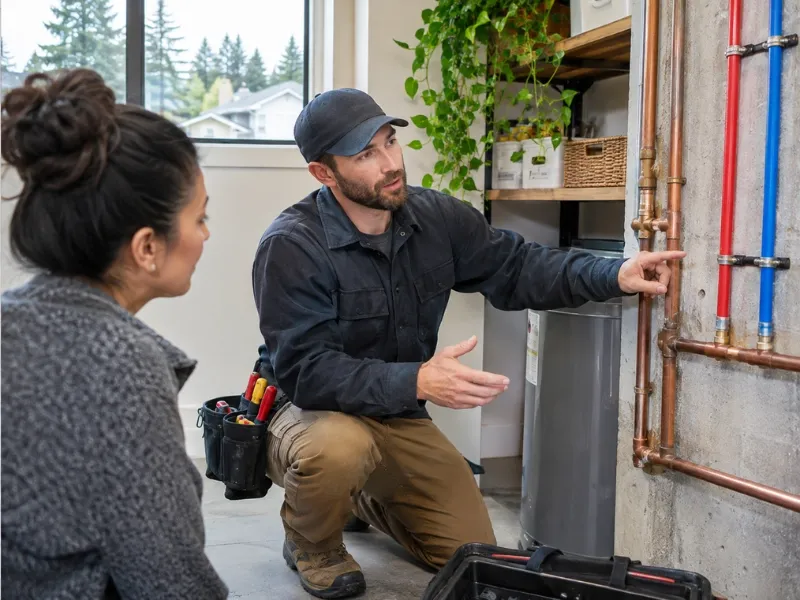
What Should A Local Plumber Know About Bellevue Homes?
A good local plumber should know what's inside Bellevue's walls, decade by decade. They should also know how water pressure behaves on the city's hills, and which state and city rules apply to the work. That knowledge saves you money, because nobody has to guess. We're Eastside Repipe and Plumbing, a family-owned shop on NE 12th Street, and most of what we do starts with it.
By Ramin Shahbaziasl, Owner and Lead Plumber · Last updated November 3, 2026
Who is legally allowed to work on plumbing in a Washington home?
In Washington, only L&I-certified plumbers are able to legally perform plumbing on another person’s property. So to answer your question, are plumbers required to be licensed in Washington State? Well the answer is yes. The only exception to this is yourself. Owners can do plumbing on their property.
The Washington L&I plumber certification program spells this out plainly. In practice, it means:
A certified plumber can work on your home.
A plumber trainee can too, but only while carrying a trainee certificate and working under a certified plumber's supervision.
A handyman can't take on plumbing work, however small it seems, without the right certificate.
You can fix your own faucet, though permits still apply to bigger jobs.
The rule protects you as much as anyone. Uncertified work can cause trouble later with inspections, insurance claims and even a home sale.
There's a second layer, too. The person holds the certificate, while the company holds a contractor registration. You want both. Our guide on what a licensed plumbing contractor really means walks through how they differ.
What's behind the walls in Bellevue homes from each era?
The pipes in a Bellevue home depend a lot on when it was built. Bellevue grew fast after the war, and each building boom left its own plumbing behind.
That's where a family owned local plumbing company Bellevue Washington homeowners have used for years earns its keep. We've opened up walls from every era, so we know what to expect before the first cut. Here's the rough pattern:
When the home was built | What's often in the walls | What we watch for |
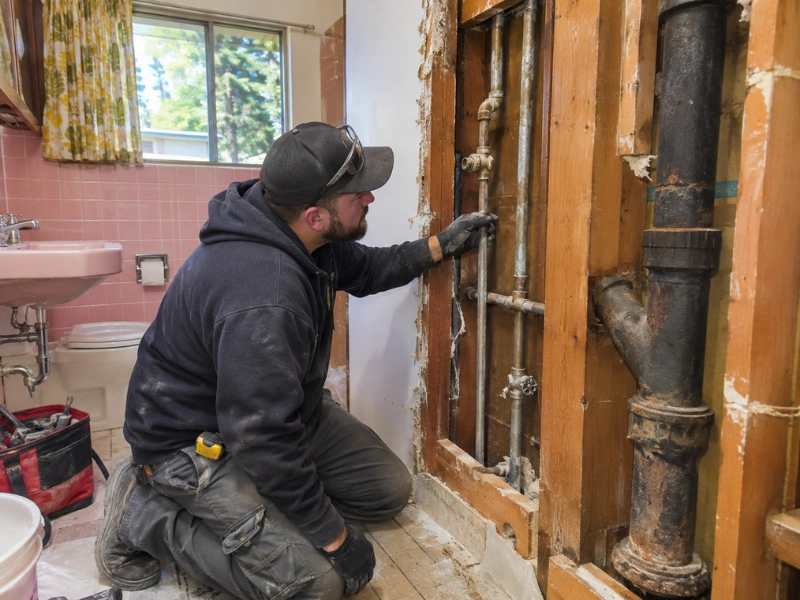
1950s and 1960s ramblers | Galvanized steel supply, cast iron drains | Rust inside the pipe, low pressure, slow drains |
1970s | Copper supply lines | Pinhole leaks on hot water lines |
Late 1970s to mid 1990s | Polybutylene (gray plastic) in some homes | Cracked fittings and sudden failures |
Late 1990s to 2000s | Copper, CPVC or early PEX | Mixed materials joined during remodels |
2010s onward | PEX, often with a manifold | Fewer surprises, but check any DIY repairs |
Neighborhoods like Lake Hills and Crossroads are full of those 1950s and '60s ramblers, so galvanized pipe still turns up there more often than you'd think. None of this is a rule, though, because plenty of homes were repiped along the way. Still, if your house dates from the mid-'80s, it's worth checking for gray plastic pipe. Our post on polybutylene pipe in Bellevue homes shows what it looks like.
How does Bellevue's water pressure affect your plumbing?
In some areas of Bellevue there is higher pressure coming into your home than was designed for your fixtures. As Bellevue has hills and valleys throughout the city pressure can vary between different neighborhoods.
According to plumbing codes if there is more than 80psi coming into your house, you are required to have a pressure reducing valve (PRV). Most homes in high pressure areas will have one fitted near the point of entry. These however do not last forever and symptoms will gradually start to show if one fails:
Banging pipes when a faucet shuts off.
Toilets that run or refill on their own.
A dripping relief valve on the water heater.
Faucet and appliance hoses wearing out early.
You can check it yourself with a cheap gauge from a hardware store. Just screw it onto an outdoor hose bib and read it with everything inside turned off. If it's well over 80, call us before something gives. Swapping a worn PRV is usually a quick job, and it protects every fixture downstream.
Why do backflow tests and permits matter on a Bellevue job?
They matter because the work isn't really finished until it's legal and on record. A local plumber deals with both all the time, while an out-of-area crew may not even think to ask.
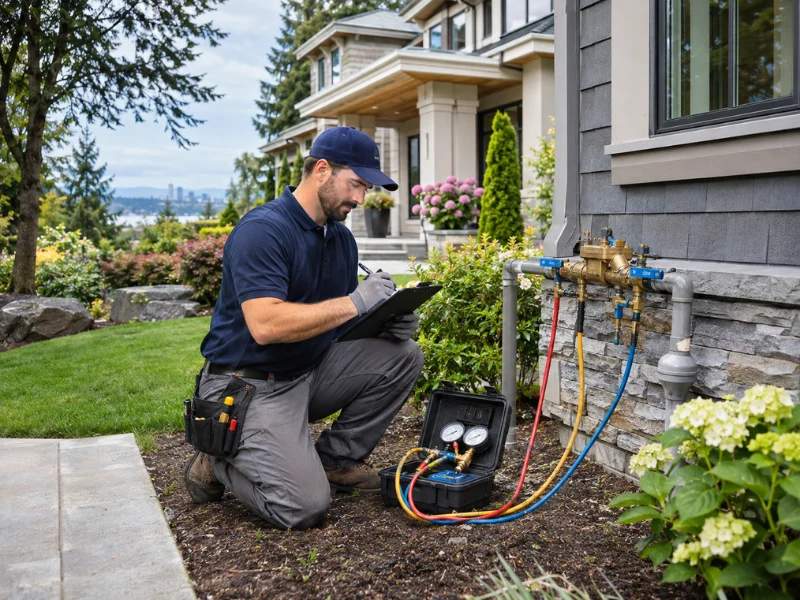
Backflow is the first one. Most home irrigation systems will require a backflow assembly to prevent irrigation water from flowing back into the city water supply. Cross connection programs are conducted by the water utility companies in Washington. These assemblies are typically tested annually by a certified tester.
Permits are the second. Bigger jobs, like water heater replacements and repipes, generally need a plumbing permit and an inspection. Skipping that might save a week now. However, it can come back when you sell, since Washington's seller disclosure form asks about work done without required permits.
What should a plumber's ad legally show in Washington?
Under state law, any ad showing a contractor's name or address has to show their current registration number too. That makes the ad itself your first quick check.
According to RCW 18.27.100, that rule also covers materials a contractor uses to solicit business directly from homeowners, such as flyers and door hangers. A contractor also can't use a false or expired number. So when you're searching for a licensed and bonded plumber Bellevue WA homeowners trust, look for that number first.
If there is no registration number on advertisement, truck, or flyer then it should be viewed with suspicion. Those who are looking to find out how to verify plumbers license can follow the steps in the link above. Those seeking a Plumbers license certified by Washington L&I will find it easier to find one if they start with whoever has their number prominent.
Where do we work around Bellevue?
We service all areas of Bellevue including; West Bellevue, Bridle Trails, Lake Hills, Crossroads, Eastgate, Somerset, Factoria and Newport Hills. We also service Mercer Island, Kirkland, Redmond, Issaquah and Sammamish.
If you're wondering who is a trusted local plumber in Bellevue WA, our local plumber in Bellevue page shows the work we do here every week. For a broader look at choosing between companies, see our guide to which plumbers near me in Bellevue are worth calling.
Two more questions come up a lot. One is, what is the difference between a journeyman and a specialty plumber? The other is, is a local plumber better than a national franchise in Bellevue Washington? We answer both in the FAQs below.
Frequently asked questions
1. Is your plumber certification current with Washington L&I?
Yes. Our plumbers work under Washington L&I plumbing certification, and we're happy to give you the certificate numbers before any work starts. You can look each one up by name on L&I's Verify tool, which shows the certificate type and whether it's active.
2. Are you bonded and insured for work in Bellevue?
To stay registered in Washington, a contractor has to file a bond and carry general liability insurance, and L&I shows both on the company's public record. Ask us for our registration number and you can check the bond and insurance status yourself. Keep in mind that the state bond has a fixed limit, so it won't cover a large loss on its own. That's why the contractor's insurance and a written contract matter more.
3. Journeyman or specialty: which does my job need?
Most home repairs can be handled by either a journey level plumber or a residential specialty plumber. A journey level plumber can work on any type of building, including commercial. A residential specialty plumber is limited to residential buildings, such as houses, duplexes and smaller apartment buildings. Other specialty certificates cover narrower work, like pump and irrigation systems or backflow testing.
4. Do I get a written estimate before any work starts?
Yes. Every job starts with a free written estimate that lists the work, materials and price before anything begins. If we find something unexpected once the work is underway, we stop and explain it first. You approve any change in writing before we carry on. Nothing gets added to the bill without your okay.
5. Local company or franchise: does it change what I pay?
It can, though not always the way people expect. Many franchises price from a set menu, called flat-rate pricing, and carry national marketing and overhead costs. Local shops may use flat rates too, or charge for time and materials. The only fair comparison is two written estimates for the same scope of work, side by side.
Visit or Call Us
Eastside Repipe And Plumbing
Address: 12005 NE 12th St # 29, Bellevue, WA 98005
Phone: 425-331-2011
Email: [email protected]
Family-owned plumbing and repiping company
Serving Bellevue, Mercer Island, Kirkland, Redmond, Issaquah, Sammamish and the wider Eastside. Call for a free written estimate, or use our contact page to book a visit.
