Hydronic Heating Installation: Costs and Types
By Ramin Shahbaziasl, Owner, Eastside Repipe and Plumbing · Last updated October 03, 2025
Hydronic heating moves warm water through tubing rather than blowing hot air through ducts. The result is even, quiet heat with no drafts, no dust circulation, and no dry air.
The system itself is well proven. What determines whether it works well in your home is the design: the right heat source, the right system type for your floor structure, and zoning that matches how you actually live. This guide covers all three.
If you are still deciding between hydronic and electric floor heating, our radiant floor heating guide covers that comparison. This article is about the hydronic system itself.
What Makes Up the System
A heat source. A boiler or, increasingly, a heat pump
PEX tubing. Flexible, durable, and rated for decades in service
Manifolds. Distribute and balance flow across zones
Circulator pumps. Move water through the loops
Controls. Thermostats, zone valves, and sensors
The tubing is the part that lasts. The heat source is the part you will replace at least once during the life of the system, which is why choosing it well matters more than most guides suggest.
The Heat Source Decision
This is the most consequential choice in the whole project, and it is where a lot of hydronic content is out of date.
Gas boiler. The traditional option. Fast, effective, and well understood. Requires adequate gas supply and correct venting.
Air-to-water heat pump. The option worth serious consideration in this region. Hydronic radiant runs at low water temperatures, and low supply temperature is exactly the condition heat pumps are most efficient at. The two are a natural technical match.
That matters locally. Electricity dominates residential heating across the Puget Sound, heat pumps have become the default rather than the exception, and PSE runs rebates on qualifying heat pump equipment. A hydronic system designed around a heat pump also gives you a path to cooling, which a boiler does not.
Electric boiler. Simple and compact, but expensive to run at scale. Usually only sensible for small zones.
Solar thermal or geothermal. Both pair well with hydronic, both carry significant installation cost, and both are worth modeling properly rather than assuming.
Ask any installer which heat source they are proposing and why, and whether it is included in the quoted price. It frequently is not.

The Four System Types
Which one suits you is determined by your floor structure, not by preference.
In Slab
Tubing embedded in a poured concrete slab. The slab becomes a large thermal mass that holds and releases heat slowly.
Best for: new construction, garages, basements, and slab on grade areas. Trade-off: very slow response. Excellent at holding a steady temperature, poor at reacting to changes.
Thin Slab or Overpour
Tubing laid over an existing subfloor and topped with lightweight concrete or gypsum.
Best for: renovations where you can accept some floor height gain. Trade-off: adds height and weight. The structure needs to take the load.
Dry Systems
Tubing installed in grooved panels above the subfloor, or between joists from below.
Best for: retrofits where floor height or structural load is constrained. Trade-off: less thermal mass, so output per square foot is lower. Works better with well-insulated homes.
Radiator or Baseboard
Hydronic without the floor element. Water circulates to radiators or baseboard units.
Best for: retrofits where lifting floors is not practical, and for adding heat to individual rooms. Trade-off: you lose the underfoot warmth, but keep the efficiency, quietness, and clean air advantages.
What Drives the Cost
Published per square foot figures vary so widely that they are close to meaningless without knowing the project. Here is what actually moves a quote:
Heat source. Frequently the single largest line item, and frequently quoted separately. Confirm whether it is in the number you were given
System type. In-slab during construction is the cheapest per square foot. Dry system retrofits cost more per square foot but avoid structural work
Area and zoning. More zones cost more up front and save more in operation
Floor buildup and insulation required beneath the tubing
New build or retrofit. This is the biggest single variable
Existing structure. Whether floors have to come up, and what has to go back
Get quotes itemized into heat source, floor system, controls, and labour. A quote that bundles everything into one figure cannot be compared against another. Our plumber cost guide covers typical local labour rates.

How Installation Works
Heat loss assessment. Room by room, accounting for insulation, glazing, and orientation. This determines everything downstream and is the step that gets skipped
System design. Loop layout, spacing, zoning, and heat source sizing
Insulation. Beneath the tubing, so heat goes up rather than down
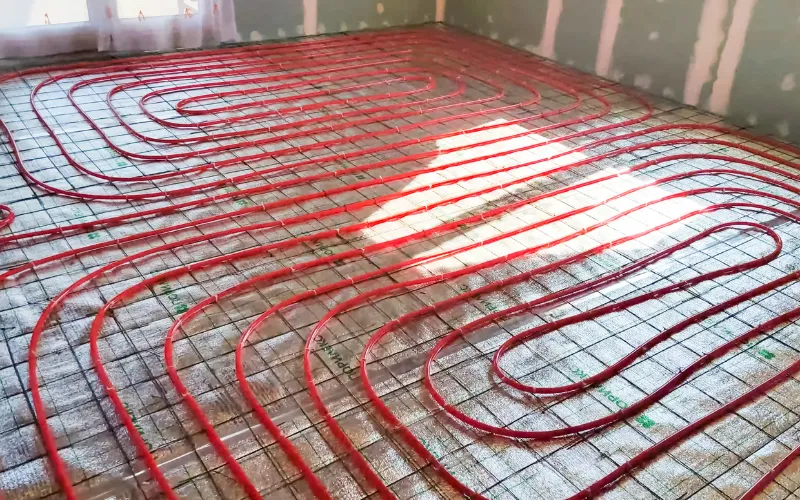
Tubing installation. Laid in loops and secured, with loop lengths kept within manufacturer limits so flow stays balanced
Manifold and heat source connection
Pressure testing. Loops are tested and held under pressure before anything is covered
Cover. Slab, overpour, or floor finish
Commissioning. Flow balanced across zones, controls configured, system tuned
Step 7 is why steps 1 through 6 matter. Once the floor is down, the system is not accessible.
Maintenance
Low maintenance, not no maintenance:
Annual heat source service. Boiler or heat pump, same as any other appliance
System pressure check. A dropping pressure indicates a leak somewhere
Periodic flush to clear sediment and maintain flow
Check the expansion tank and circulator during annual service
Verify zone controls are still balanced
The tubing itself is rated for decades. The heat source will need replacing during that time, which is worth budgeting for rather than being surprised by.
Common Mistakes
No proper heat loss calculation. Everything else follows from this, and guessing produces either cold rooms or an oversized heat source
Skipping insulation beneath the tubing. Heat driven into the ground is heat you paid for
Undersized or oversized heat source. Both cost money, in different ways
Loop lengths that are too long, which produces uneven output across a zone
Too few zones. Heating rooms you do not use, on the same schedule as rooms you do
Not planning for cooling. Hydronic radiant heats only. Deciding how you will cool the house afterwards is more expensive than deciding beforehand
Frequently Asked Questions
Is hydronic heating worth it?
For new construction or a full renovation, often yes. Higher install cost, lower running cost, and better comfort. As a retrofit into an occupied home in a mild climate, the payback period is long enough that comfort rather than energy savings is usually the deciding factor.
Can hydronic run off a heat pump?
Yes, and in this region it is worth designing around. Hydronic radiant operates at low supply temperatures, which is where air-to-water heat pumps are most efficient. It also gives you a route to cooling.
Can it be retrofitted into an existing home?
Yes. Dry systems and radiator-based hydronic both work without lifting slabs. Thin slab overpour is possible where floor height and structural load allow.
How long does installation take?
Typically one to three weeks depending on scope, plus lead time on the heat source. New construction integrates into the build schedule.
Is it safe?
It is a sealed, low-temperature water system with no combustion in the living space. Surface temperatures are limited by design. The heat source itself carries the same considerations as any boiler or heat pump.
How long does it last?
Tubing is rated for several decades. The heat source is the wear item, typically needing replacement well before the tubing does.
Get the Design Right First
Almost every hydronic system that disappoints was designed badly rather than built badly. Heat loss calculation, heat source selection, zoning, and insulation are what determine whether you are happy with it in ten years.
Get a free consultation or call 425-331-2011. We will assess the space, model the heat load properly, recommend a heat source that suits how the house is actually used, and quote the full system in writing.
You can verify our licence, bond, and insurance for free through the state Department of Labor and Industries before you book anything.
See our specialized plumbing services for the hydronic and radiant work we handle. We serve Bellevue, Kirkland, Redmond, Seattle, and the wider Eastside service area.
