Commercial Repiping in Kirkland WA: Planning a Repipe Without Shutting Down
Eastside Repipe And Plumbing handles commercial repiping Kirkland property owners and business operators need when aging supply lines threaten to disrupt operations. We perform commercial building repipe and business plumbing replacement projects across office buildings, retail spaces, restaurants, and multi-tenant properties — with phased scheduling designed around your business hours, not ours.
By Ramin Shahbaziasl, Owner · Last updated June 2026
What Is Commercial Repiping?
Commercial repiping is the replacement of a commercial building's water supply system — the lines that bring potable water from the utility connection to every fixture, restroom, kitchen, and mechanical system in the building. It's the commercial-scale equivalent of a residential whole-home repipe, but with a different set of constraints: larger pipe diameters, more complex distribution systems, fire suppression interfaces in some buildings, and the operational reality that most commercial properties can't simply shut down for two weeks.
Commercial pipe install work typically falls into a few categories:
Full building repipe — replacing the entire supply system from the main connection through every branch line
Partial or phased repipe — replacing sections by floor, wing, or tenant space while the rest of the building stays operational
Riser replacement — replacing the vertical supply risers in multi-story buildings, often the highest-priority component in older commercial structures
Fixture branch replacement — replacing the supply lines serving restrooms, break rooms, or kitchen areas without touching the main distribution system
Kirkland's commercial building stock includes a mix of 1970s–1990s office and retail construction along Kirkland Avenue and the Totem Lake area, alongside newer mixed-use development closer to downtown and the waterfront. The older stock is where most of our commercial repiping calls originate — galvanized or early copper systems reaching the end of their service life, the same failure pattern we see in residential properties but at commercial scale.
Signs a Commercial Building Needs Repiping
The signs are similar to residential failure patterns, just with higher stakes given tenant and customer impact:
Pressure complaints across multiple units or floors — when several tenants report low pressure simultaneously, the issue is in the shared supply system, not an isolated fixture
Recurring leaks at risers or main distribution lines — a leak in a wall cavity or ceiling space in a commercial building often isn't discovered until it's caused visible damage
Rust-tinted water from fixtures — the same corrosion indicator as residential galvanized failure, but affecting every tenant or customer who uses the water
Water damage claims or insurance flags — commercial property insurers increasingly flag buildings with known aging plumbing infrastructure during renewal underwriting
Building age and system type — buildings constructed before 1985 in the Kirkland area, particularly those that haven't had supply line work since original construction, are the most likely candidates
Minimizing Business Downtime During Repipe
This is the question every commercial property owner asks first, and it's the right one. Here's how we approach a commercial repipe project planning guide for minimizing disruption:
Phased scheduling by zone. Rather than shutting off water to the entire building, we phase the work by floor, wing, or tenant space. Water service to unaffected areas continues normally while we work in a contained zone.
After-hours and weekend work. For retail, restaurant, and customer-facing properties, water shutoffs scheduled during off-hours minimize the operational impact. We coordinate scheduling directly with property management or business ownership to find windows that work.
Temporary water service for critical areas. For restrooms or break areas that can't go offline, we can sometimes establish temporary supply routing during the transition between old and new piping.
Clear communication with tenants. For multi-tenant buildings, we provide a written schedule that property management can distribute to tenants in advance — specific dates, specific zones, expected duration. No surprises.
Sequencing to limit re-entry. We plan the work order to minimize the number of times we need to re-enter a finished space, which reduces both disruption and the risk of damaging completed work.
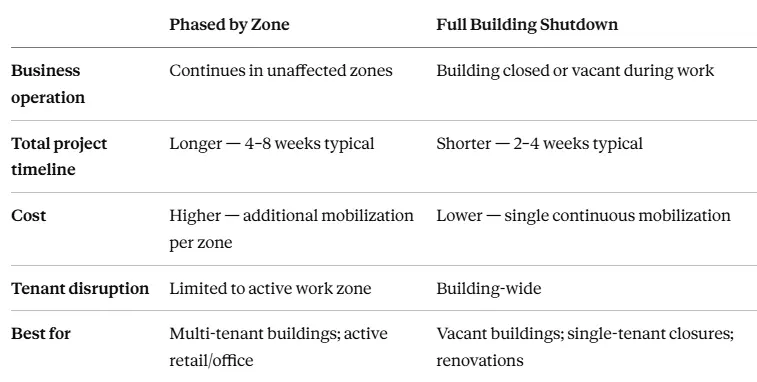
The best commercial repiping contractors in Kirkland plan the schedule around your operation, not the other way around. Here's how the two main scheduling approaches compare:
Call 425-331-2011 to discuss a phasing plan for your specific property.
What Pipes Are Best for Commercial Repiping?
The right material depends on the building type, code requirements, and budget — but here's our general guidance for Kirkland commercial properties:
PEX-A is increasingly the standard for commercial branch lines and many main distribution applications. It's faster to install, which directly reduces labor cost and downtime — a meaningful factor in commercial projects where labor hours translate to disruption. Kirkland's Seattle Public Utilities watershed water is soft and low in minerals, which favors PEX longevity.
Copper remains the standard for certain commercial applications — particularly where local code or specific building systems require it, and for risers in multi-story buildings where copper's rigidity and proven long-term performance are valued. Copper repiping costs more in material and labor but offers a longer documented service life.
CPVC is used in some commercial applications, particularly for fire sprinkler-adjacent systems where specific code requirements apply. We assess code requirements for your specific building type before recommending a material.
Most Kirkland commercial repipe projects use a combination — copper or CPVC at the main risers and PEX-A for branch distribution to individual units or fixture groups. We design the material plan around your building's specific code requirements and budget.
How Much Does Commercial Repiping Cost in Kirkland?
We don't publish cost ranges without a verified local source — commercial repiping cost depends heavily on building size, number of floors, occupancy type, material selection, and phasing complexity. What we will tell you:
Scope drives cost more than any other factor — a single-tenant office repipe and a multi-tenant retail building repipe are not comparable projects
Phasing adds cost but reduces disruption — a phased approach typically costs more than a single continuous shutdown, because of the additional mobilization and sequencing required
Kirkland's commercial labor rates are among the highest in Washington State
Permit and engineering review for larger commercial projects add to both cost and timeline
Call 425-331-2011 for a walkthrough and written estimate scoped to your specific building.
How Long Does Commercial Repiping Take?
Timeline varies significantly by building size and phasing approach:
Small commercial space (single tenant, under 5,000 sq ft) — typically completes in one to two weeks
Multi-tenant building with phased scheduling — often spans four to eight weeks, working zone by zone to keep most of the building operational throughout
Full building shutdown approach — faster overall (often two to four weeks for a mid-size building) but requires the building to be vacant or substantially closed during the work
Most Kirkland commercial property owners choose phasing over full shutdown specifically because the extended timeline is preferable to a complete operational stop. We scope the realistic timeline during the walkthrough based on your building's layout and tenant situation.
Do I Need a Permit for Commercial Repiping in Kirkland?
Yes. Under the City of Kirkland Building Permits requirements, commercial plumbing system replacement requires a permit, and larger commercial projects typically require engineered plans depending on scope and occupancy classification. Commercial permitting generally involves more review than residential — particularly for buildings with food service, healthcare, or assembly occupancy classifications under the Washington State Building Code Council standards.
Washington State L&I requires all commercial plumbing work to be performed by a licensed contractor. Eastside Repipe And Plumbing holds an active Washington State plumbing contractor license and manages the full permit process — submission, plan review coordination where required, inspection scheduling, and final close-out.
Commercial Repiping Across Kirkland and the Eastside
Eastside Repipe And Plumbing handles commercial repiping Kirkland and surrounding Eastside commercial properties:
Kirkland — Totem Lake commercial corridor, downtown Kirkland office and retail, Kirkland Avenue commercial buildings
Bellevue — downtown high-rise and mid-rise commercial properties, Crossroads retail
Redmond — Overlake corridor office and retail
We work with property managers, building owners, and tenant representatives directly to scope and schedule commercial projects throughout the King County Eastside.
Frequently Asked Questions
1. How much does commercial repiping cost in Kirkland?
Cost depends on building size, occupancy type, material selection, and phasing approach. We don't publish ranges without a verified local source — every commercial project is scoped individually. Call 425-331-2011 for a walkthrough and written estimate.
2. How long does a commercial repipe take?
Small single-tenant spaces typically complete in one to two weeks. Multi-tenant buildings using phased scheduling often span four to eight weeks to keep most of the building operational. A full shutdown approach is faster overall but requires the building to be vacant during the work.
3. Can my business stay open during repiping?
In most cases, yes. We use phased scheduling by floor, wing, or tenant space, after-hours and weekend work for customer-facing areas, and sequencing designed to minimize disruption. Full closure is sometimes the faster option for smaller buildings, but most Kirkland commercial clients prefer a phased approach that keeps operations running.
4. What pipes are best for commercial repiping?
PEX-A is increasingly standard for branch distribution due to faster installation and lower labor cost. Copper remains standard for risers and certain code-required applications in multi-story buildings. CPVC is used in some fire-sprinkler-adjacent systems. Most Kirkland commercial projects use a combination based on the building's specific code requirements.
5. Do I need a permit for commercial repiping in Kirkland?
Yes. The City of Kirkland requires a permit for commercial plumbing system replacement, and larger projects may require engineered plans depending on occupancy classification. Washington State L&I requires a licensed contractor for all commercial plumbing work. Eastside Repipe And Plumbing manages the full permit and inspection process.
Contact Eastside Repipe And Plumbing
Eastside Repipe And Plumbing 12005 NE 12th St # 29 Bellevue, WA 98005 Phone: 425-331-2011 Hours: Available 7 days a week
Serving Kirkland, Bellevue, Redmond, Bothell, Kenmore, and all of King County, WA.
